
The FD&C Act didn’t start out as a law for generic drugs. In 1938, it was born out of tragedy - over 100 people died after taking a toxic antibiotic called elixir sulfanilamide. No one had checked if it was safe. No one was required to. That horror pushed Congress to act, and President Roosevelt signed the Federal Food, Drug, and Cosmetic Act into law. It gave the FDA power to demand proof that drugs were safe before they hit the market. But safety alone wasn’t enough. For decades, the law didn’t even require drugs to work.
Before Generics: A Broken System
For nearly 25 years after the FD&C Act passed, drug companies only needed to prove their products were safe. Efficacy? Not required. That changed in 1962, after the thalidomide crisis. The Kefauver-Harris Amendments added a new rule: every new drug had to prove it was both safe and effective. But here’s the catch - if you wanted to make a copy of a brand-name drug, you still had to run full clinical trials. The same expensive, years-long studies. The same thousands of patients. Even though the original drug had already been proven safe and effective. It made no sense.
By the early 1980s, only about 19% of prescriptions in the U.S. were filled with generics. That’s because the cost to bring a copy to market was almost as high as developing the original. Why would a company risk millions just to copy something that already existed? The result? Patients paid more. The system was broken.
The Hatch-Waxman Breakthrough
In 1984, Congress fixed it. The Drug Price Competition and Patent Term Restoration Act - better known as the Hatch-Waxman Amendments - rewrote how generic drugs could get approved. It didn’t rewrite the FD&C Act. It added a new section: 505(j). That’s the legal engine behind every generic drug you’ve ever taken.
Here’s how it works. Instead of redoing clinical trials, generic manufacturers now submit an Abbreviated New Drug Application, or ANDA. All they need to prove is one thing: bioequivalence. Their pill must deliver the same amount of active ingredient into the bloodstream at the same rate as the brand-name drug. The FDA measures this using blood tests that track two key numbers - Cmax and AUC. If the generic’s results fall within 80% to 125% of the brand’s, it’s approved. No need to retest safety. No need to reprove effectiveness. The original drug already did that.
This wasn’t just a shortcut. It was a revolution. By 2024, 90% of prescriptions in the U.S. were filled with generics. Yet they made up only 17% of total drug spending. That’s how much money this law saved patients and the healthcare system.
The Patent Balancing Act
Hatch-Waxman didn’t just make it easier to copy drugs. It also protected the companies that invented them. Brand-name drug makers get up to five extra years of patent life to make up for the time lost during FDA review. That’s fair. Innovation needs incentive.
But here’s the clever part: the first generic company to challenge a brand’s patent gets 180 days of exclusive market rights. No other generic can enter during that time. That’s a massive financial reward. It turns patent challenges from a risky legal battle into a profitable race. That’s why so many generic companies now have legal teams working on patent disputes - not just manufacturing.
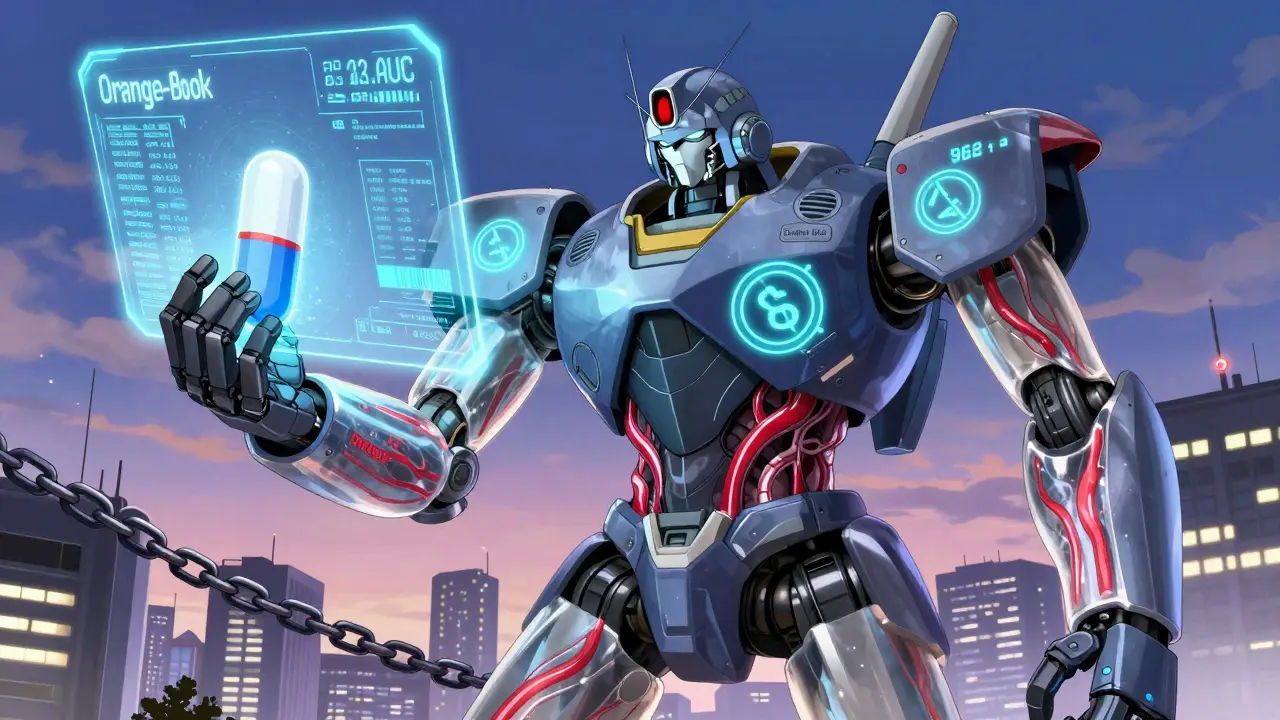
The FDA keeps a public list called the Orange Book. It shows every approved drug, its patent numbers, and its therapeutic equivalence rating. Generic manufacturers use this like a map. If a patent is listed, they must certify whether they believe it’s invalid, unenforceable, or will expire soon. That certification triggers legal notice to the brand-name company. If they sue, the FDA pauses approval for 30 months - unless the generic wins in court.
Where the System Still Stumbles
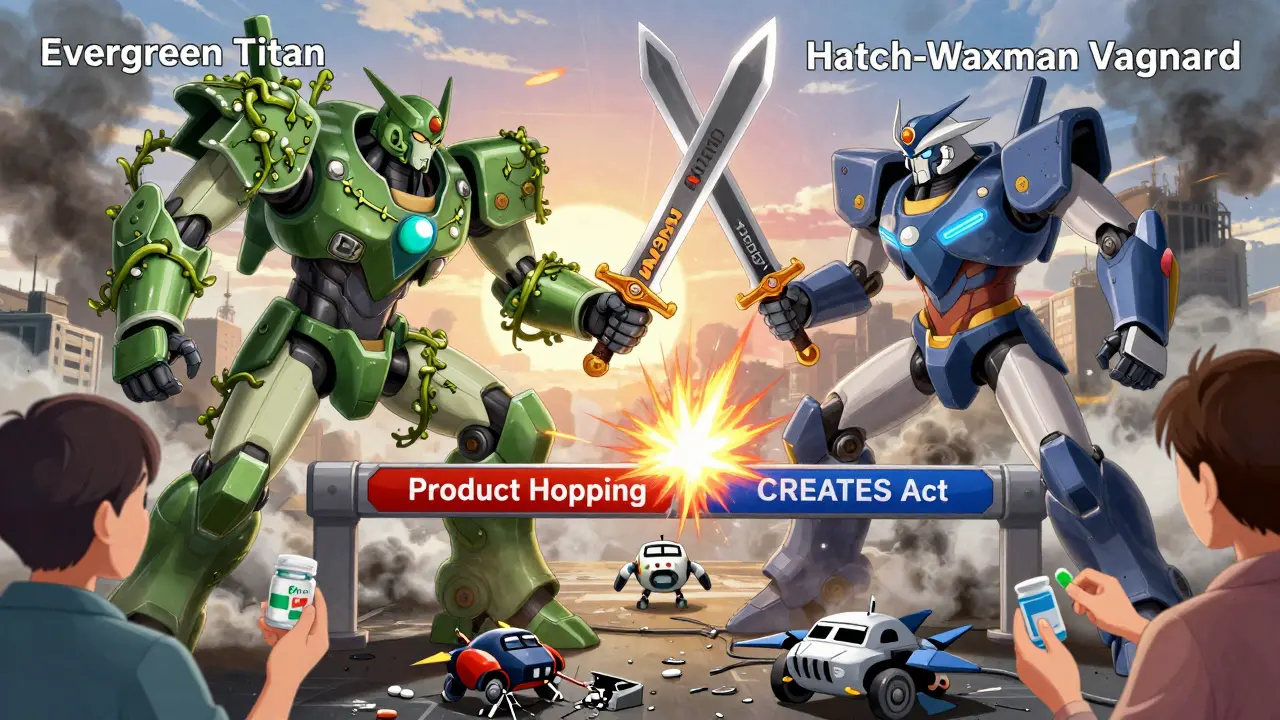
For all its success, Hatch-Waxman wasn’t perfect. Brand-name companies learned to game the system. One tactic? “Evergreening.” They file new patents on minor changes - a new coating, a different pill shape, a slightly altered release mechanism - just before the original patent expires. These aren’t real innovations. They’re legal tricks to block generics.
Another? “Product hopping.” A company pulls its brand-name drug off the market and replaces it with a slightly modified version. Then they claim the generic can’t be substituted. It’s not illegal, but it’s designed to confuse pharmacists and doctors - and delay generic use.
Then there’s the issue of complex drugs. Inhalers, injectables, creams - these aren’t simple pills. Their bioequivalence is harder to prove. The FDA has only recently started issuing clear guidance for these products. As of 2023, generic entry for complex drugs was 42% slower than for simple pills. That means patients still pay more for these essential treatments.
Enforcement and Compliance: The Hidden Costs
Getting approved isn’t the end. Generic manufacturers must follow strict rules under the FD&C Act. Every step - from making the active ingredient to packaging the final pill - must meet current Good Manufacturing Practices (cGMP). The FDA inspects factories. In 2022, 47 warning letters went out to generic drug makers. The most common problems? Poor quality control and data integrity. One lab falsified test results. Another didn’t clean equipment between batches. Both are violations of the FD&C Act.
Violations can mean fines up to $1.1 million per incident. Or worse - criminal charges. That’s why companies spend millions on compliance teams. It’s not just about getting approved. It’s about staying approved.
What’s Next? The Future of Generics
The FDA has been updating the system. The Generic Drug User Fee Amendments (GDUFA), first passed in 2012 and renewed in 2022, give the agency more funding to hire reviewers and improve inspections. In 2022, 98% of priority ANDAs were approved within 10 months - a huge jump from the 30+ months it took in the 1990s.
The 21st Century Cures Act and the CREATES Act of 2019 tried to fix the biggest loopholes. CREATES, for example, forces brand-name companies to sell samples of their drugs to generic makers. Before, some refused - blocking testing and delaying approval. Now, they can’t.
The FDA’s 2023-2027 plan says it will focus on modernizing approval for complex drugs. Draft guidance for nasal sprays and eye drops is coming in 2024. That’s good news. These drugs treat asthma, glaucoma, and other chronic conditions. If generics can’t enter this space, patients stay locked into expensive brands.
The Congressional Budget Office estimates the current system will save $158 billion in federal drug spending over the next decade. That’s the power of a well-designed law. The FD&C Act didn’t create the generic drug market. Hatch-Waxman did. But without the FD&C Act’s foundation - the authority to regulate safety, enforce standards, and require proof - Hatch-Waxman wouldn’t have been possible.
Why This Matters
Every time you pick up a generic pill, you’re holding the result of a 90-year legal evolution. It started with a tragedy. It was fixed by smart legislation. And it continues to adapt. The FD&C Act isn’t just a law. It’s a living framework that balances innovation with access. It keeps drugs safe. It keeps them affordable. And it keeps competition alive.
Without it, generics wouldn’t exist. And millions of people - including you - would pay far more for the medicines they need.
What is the FD&C Act and why is it important for generic drugs?
The Federal Food, Drug, and Cosmetic Act (FD&C Act), passed in 1938, gave the FDA authority to regulate drug safety. While it didn’t originally cover generics, it created the legal foundation for all drug regulation in the U.S. The Hatch-Waxman Amendments of 1984 added Section 505(j) to the FD&C Act, which established the Abbreviated New Drug Application (ANDA) pathway - the legal process that allows generic drugs to be approved without repeating costly clinical trials. Without the FD&C Act, there would be no FDA oversight, and no legal framework for generic drug approval.
How do generic drugs get approved under the FD&C Act?
Generic drugs are approved through an Abbreviated New Drug Application (ANDA) under Section 505(j) of the FD&C Act. To get approval, manufacturers must prove their product is pharmaceutically equivalent (same active ingredient, strength, dosage form, route) and bioequivalent (delivers the same amount of drug into the bloodstream at the same rate) as the brand-name reference drug. The FDA uses blood tests to measure Cmax and AUC, and requires the generic’s results to fall within 80-125% of the brand’s. No new clinical trials are needed.
What is the Hatch-Waxman Amendments and how did it change generics?
The Hatch-Waxman Amendments of 1984 created the modern system for generic drug approval. Before Hatch-Waxman, generic makers had to submit full new drug applications (NDAs) with clinical trial data - making generics too expensive to develop. Hatch-Waxman introduced the ANDA pathway, allowing generics to rely on the brand’s safety and efficacy data. It also created patent challenges and a 180-day exclusivity period for the first generic to file, which spurred competition. It balanced innovation with access, turning generics from a niche market into the standard.
Why do some generic drugs still take a long time to reach the market?
Even with the ANDA process, delays happen. Brand-name companies often file secondary patents to extend exclusivity - a tactic called “evergreening.” They may also delay sharing drug samples (called “product hopping”) or file citizen petitions to block approvals. Complex drugs like inhalers or injectables are harder to replicate, and the FDA has only recently developed clear guidance for them. These factors can delay generic entry by years, even after patents expire.
Are generic drugs as safe and effective as brand-name drugs?
Yes. The FDA requires generics to meet the same strict standards as brand-name drugs. They must have the same active ingredient, strength, dosage form, and route of administration. Bioequivalence testing ensures they deliver the same amount of medicine into the bloodstream at the same rate. The FDA monitors both brand and generic drugs equally after approval. Over 90% of prescriptions in the U.S. are filled with generics - and they’ve been used safely by millions for decades.
What role does the FDA’s Orange Book play in generic drug approval?
The Orange Book - officially called Approved Drug Products with Therapeutic Equivalence Evaluations - lists all FDA-approved drugs, their patent numbers, and therapeutic equivalence ratings. Generic manufacturers use it to identify which patents they need to challenge before filing an ANDA. If a patent is listed, the generic applicant must certify whether they believe it’s invalid, unenforceable, or will expire soon. This certification triggers legal notice and can delay approval if the brand sues. The Orange Book is the critical link between patent law and generic drug approval.



Jake Nunez
January 10, 2026 AT 10:12The FD&C Act is one of those laws that saved lives without most people ever knowing it existed. It’s not glamorous, but it’s the reason your $4 generic blood pressure pill works just as well as the $40 brand name. No drama, no hype-just science and regulation working the way they should.
Michael Marchio
January 11, 2026 AT 18:35Let’s be honest-Hatch-Waxman was a masterstroke of legislative engineering, but it’s also been systematically undermined by pharmaceutical lobbying. Evergreening? Product hopping? These aren’t loopholes-they’re features designed by lawyers paid by Big Pharma to keep prices high. The FDA’s hands are tied because Congress keeps giving them half-measures while the industry writes the rules. We’re not talking about minor inefficiencies here. We’re talking about a system that lets corporations profit off public trust while patients pay the price in dollars and health outcomes.
lisa Bajram
January 13, 2026 AT 13:44OMG I LOVE THIS HISTORY SO MUCH!! 🙌 The FD&C Act started because people died from a toxic elixir-and now? We’ve got 90% generics saving billions. It’s like a superhero origin story, but with lawyers and lab reports instead of capes. And that 180-day exclusivity for first-filers? GENIUS. It turns patent battles into a race, not a lawsuit lottery. The system isn’t perfect-yes, complex drugs are still a mess-but look how far we’ve come from 1938. We turned tragedy into a public health triumph. Someone needs to make a documentary about this.
Ted Conerly
January 13, 2026 AT 23:55Just wanted to say thank you for laying this out so clearly. I’ve been on generic meds for years and never knew the full story behind them. It’s easy to assume they’re just cheap knockoffs, but the bioequivalence standards? The FDA oversight? The fact that they’re held to the same cGMP rules? That’s not luck-that’s intentional design. People need to know this. It’s not just about saving money. It’s about justice. Everyone deserves access to safe, effective medicine, regardless of income.
Faith Edwards
January 15, 2026 AT 17:51One must observe, with a certain degree of scholarly gravitas, that the FD&C Act represents a paradigmatic triumph of regulatory rationality over market anarchism. The emergence of the ANDA pathway under Hatch-Waxman-far from being a mere administrative expedient-is, in fact, a sophisticated jurisprudential innovation that harmonizes utilitarian public health imperatives with the inviolable sanctity of intellectual property. One cannot help but note the lamentable degeneration of contemporary discourse into emotive, populist simplifications-such as ‘Big Pharma bad’-which utterly obfuscate the nuanced equilibrium this framework so elegantly maintains.
Jay Amparo
January 16, 2026 AT 21:41As someone from India where generics are the lifeline for millions, I can’t tell you how emotional this is to read. The FD&C Act didn’t just change American healthcare-it changed global access. Our companies make 40% of the world’s generics, and we learned from this system. The fact that bioequivalence is measured by Cmax and AUC? That’s science that travels. No borders. No politics. Just data. This law gave dignity to medicine. Thank you for reminding us why it matters.
Lisa Cozad
January 18, 2026 AT 14:28I work in pharmacy and see this every day. Patients get so nervous about generics-they think they’re ‘lesser.’ But the truth? The same people who make the brand-name drug often make the generic too. Same factory, same quality control. The only difference? The price tag. And sometimes? The pill looks different. But that’s just the inactive stuff-fillers, dyes, coatings. Doesn’t change how it works. If you’re worried, ask your pharmacist. They’ll show you the Orange Book entry.
Saumya Roy Chaudhuri
January 20, 2026 AT 02:57You people are missing the real scandal. The FDA’s 80-125% bioequivalence window is WAY too wide. That’s a 45% variance! I’ve seen studies where generics vary by 30% in absorption-and patients on narrow-therapeutic-index drugs like warfarin or levothyroxine get sick because of it. The FDA is cutting corners to speed up approvals. They call it ‘efficiency.’ I call it negligence. And don’t even get me started on the Chinese API factories. Half of them shouldn’t be allowed to make toothpaste, let alone life-saving meds.
anthony martinez
January 20, 2026 AT 14:20So let me get this straight: we let companies patent a pill’s color change to block generics, but if you copy the exact same active ingredient, you’re a criminal? Brilliant. Absolute genius. The only thing more American than this is charging $100 for a bottle of insulin that costs $1 to make. Someone please hand me a flag and a tinfoil hat. I’m ready to march.
Mario Bros
January 21, 2026 AT 17:27Just wanted to say-this is why I believe in government. Not the toxic kind. The kind that says ‘no more dead kids from poison medicine.’ Hatch-Waxman didn’t kill innovation. It made it sustainable. Generics let pharma fund new drugs because they’re still making money on the originals. It’s not a zero-sum game. It’s a cycle. And yeah, it’s messy. But it works. Keep pushing for better. We’re not done yet.
Jaqueline santos bau
January 22, 2026 AT 06:08And yet… we still have people dying because they can’t afford their meds, even with generics. So what’s the point of all this ‘brilliant’ legislation if the system still fails the most vulnerable? You’re celebrating bureaucracy while people skip doses because their co-pay is $50. This isn’t a victory lap-it’s a funeral march in slow motion.
chandra tan
January 23, 2026 AT 02:13Back home in India, we call these ‘copycat pills’-but we know they’re lifesavers. I remember my grandma on insulin. Brand name? Unthinkable. Generic? She lived 10 more years. That’s the real impact. No speeches. No patents. Just a pill that works. The FD&C Act didn’t just change U.S. law-it changed how the world sees medicine. We don’t need heroes. We need rules.
Jake Kelly
January 23, 2026 AT 09:35Thank you for writing this. I’m an engineer, not a medic, but I get it now. This isn’t just policy-it’s engineering for humanity. The bioequivalence math, the Orange Book, the 30-month stay… it’s all a system built to balance competing needs. Not perfect, but designed with care. That’s rare. And worth protecting.