
When a doctor writes a prescription for your child, it’s not just about the name of the medicine. It’s about the exact amount - and that amount has to match your child’s weight, age, and condition. A wrong dose can be dangerous. Too little might not help. Too much can cause serious harm, even death. This isn’t rare. According to the Institute for Safe Medication Practices, kids get medication errors three times more often than adults, and over half of those errors are dosing mistakes. You can’t just trust the label. You need to know how to check it.
Start with the weight - in kilograms
Every correct pediatric dose begins with weight. Not age. Not height. Not guesswork. Weight - and it has to be in kilograms, not pounds. Why? Because all medical calculations for children use mg/kg (milligrams per kilogram). If the label says "5 mL" but doesn’t show the dose in milligrams or the child’s weight in kg, it’s incomplete. That’s a red flag.
Many parents don’t realize that doctors and pharmacists convert pounds to kilograms using one exact number: 1 kg = 2.2 lb. So if your child weighs 22 pounds, that’s exactly 10 kg (22 ÷ 2.2 = 10). If the label says your child is 25 lbs but the dose is calculated for 20 lbs? That’s a mistake waiting to happen. Always confirm the weight on the label matches what you know. If it doesn’t, ask for a correction.
Look for the dose in milligrams - not milliliters
Here’s where most parents get confused. The label says "Give 10 mL." But 10 mL is a volume. It doesn’t tell you how much medicine is in it. The real safety number is the milligram amount - the actual drug dose.
For example, amoxicillin comes in different concentrations: 80 mg/mL or 40 mg/mL. If the prescription says "10 mL," but the concentration is 80 mg/mL, your child gets 800 mg. If the concentration is 40 mg/mL, they get only 400 mg. That’s a 100% difference. The FDA now requires all pediatric liquid medicines to list both the volume (mL) and the total milligrams (mg) on the label. If you don’t see the mg amount clearly printed, ask the pharmacist to write it in.
One mother in Pennsylvania nearly gave her 18-month-old a 3x overdose because she confused two different concentrations of acetaminophen. She thought "160 mg per 5 mL" meant "160 mg per 1 mL." That’s why you must always ask: "What is the exact dose in milligrams?"
Verify the calculation: mg/kg or mg/m²
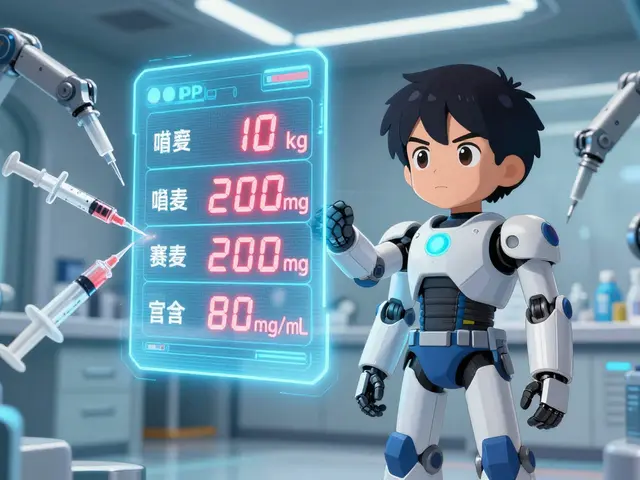
Pharmacists are trained to calculate doses using weight-based formulas. The most common is mg/kg. If your child weighs 10 kg and the prescribed dose is 40 mg/kg/day, the total daily dose is 400 mg. If it’s given twice a day, each dose is 200 mg.
For chemotherapy or certain antibiotics, doctors use mg/m² (milligrams per square meter of body surface area). This needs both weight and height. The FDA recommends the Mosteller formula: √[height(cm) × weight(kg) ÷ 3600]. It’s complex, but the pharmacist should do the math and show you the result.
Don’t rely on old rules like Clark’s Rule (weight in lbs ÷ 150 × adult dose). The American Academy of Pediatrics says it’s outdated. Direct mg/kg calculations are more accurate. Ask: "How was this dose calculated?" If they say "We just used the chart," ask to see the calculation. You have the right to know.

Check the concentration and volume
Here’s a real example: A child needs 200 mg of amoxicillin. The pharmacy dispenses it as 80 mg/mL. So 200 mg ÷ 80 mg/mL = 2.5 mL. But the syringe doesn’t have a 0.5 mL mark. What do they do?
Good pharmacies don’t give 2.5 mL. They choose a standardized dose - like 160 mg (2 mL) or 240 mg (3 mL) - based on what’s measurable and safe. This is called "rounding to interval doses." It’s not a mistake. It’s a safety feature. The American Society of Health-System Pharmacists says this reduces errors by 40%.
But if the label says "2.5 mL" and the syringe only has 0.1 mL marks? That’s risky. Ask if there’s a better option. If the pharmacy says "It’s the only concentration we have," push back. Ask for a different formulation or a different pharmacy.
Double-check with two methods
Pharmacists are required to do dual verification for every pediatric dose. That means two different people calculate the dose independently. One might use a calculator. Another might use a dosing app or manual chart. If they get different answers? The order is held until they resolve it.
You can do this too. Use two methods:
- Do the math yourself: weight in kg × dose in mg/kg = total dose
- Use the manufacturer’s dosing chart - most come with printed tables or QR codes
For example, if your child weighs 15 kg and the dose is 20 mg/kg/day for amoxicillin, the total is 300 mg/day. If it’s given twice a day, each dose is 150 mg. Now check the bottle: Is it 150 mg per dose? Is the concentration listed? Is the volume correct? If all three match, you’re safe.
Ask the three FDA-recommended questions
The FDA gives parents a simple script to use at the pharmacy:
- "What is the exact dose in milligrams, not milliliters?" - This forces them to state the drug amount.
- "Is this dose appropriate for my child’s current weight?" - This triggers the calculation check.
- "Can you show me how to measure this dose with the provided device?" - This ensures you can give it correctly at home.
One nurse in a pediatric ICU told a Reddit user: "The most dangerous thing is when parents think a dose is too small and skip it. But for a 10-pound baby, 5 mL might be perfect." Don’t assume. Ask.

Watch out for common mistakes
Here are the top three errors, based on data from the Pennsylvania Patient Safety Authority and CDC:
- Conversion errors - Mixing up pounds and kilograms. (22% of all errors)
- Concentration confusion - Not realizing 80 mg/mL is twice as strong as 40 mg/mL. (37% of liquid errors)
- Wrong rounding - Giving 2.8 mL when the syringe can’t measure it accurately. (29% of errors)
Also watch for orders written as "Give 10 mL" without any mg amount. That’s not acceptable. The ISMP says such orders must be clarified before filling. If you see this, don’t pick it up. Call the pharmacy. Ask them to contact the doctor.
Technology helps - but don’t rely on it alone
Hospitals use smart systems like EPIC and Cerner that auto-calculate doses and flag errors. Some use AI tools that check against 15,000+ guidelines. These systems are accurate - 98%+ in trials. But they’re not perfect. If a child’s weight is entered wrong, the system will give a wrong dose. That’s why human verification still matters.
Even with all the tech, the best safety net is you. Know your child’s weight. Know the dose in mg. Know the concentration. Know the volume. If anything feels off, ask again. Twice. Three times if needed.
What to do if something seems wrong
Trust your gut. If the dose looks too high or too low - even if it’s "what the doctor ordered" - stop. Don’t give it. Call the pharmacy. Call the doctor. Ask for a second opinion. You’re not being difficult. You’re preventing harm.
A parent in Texas caught a 2.5x overdose because she noticed the label said "10 mL" for a 4-year-old, but the dose should’ve been 200 mg (2.5 mL). She called the pharmacy and found out the pharmacist had misread the weight. The child was saved. That could’ve been you.
Medication safety isn’t just for doctors and pharmacists. It’s a team sport. And you’re the captain.
What should I do if the prescription label doesn’t list my child’s weight in kilograms?
If the label doesn’t show your child’s weight in kilograms, ask the pharmacist to write it in. All pediatric doses must be calculated using kg, not pounds. If they refuse or say it’s "not necessary," ask to speak with the pharmacy manager. You have the right to see the calculation used to determine the dose.
Can I use a kitchen spoon to measure my child’s medicine?
Never use a kitchen spoon. They vary too much - a teaspoon can hold anywhere from 3 mL to 7 mL. Always use the dosing device that comes with the medicine: a syringe, dropper, or measuring cup. If you lost it, ask the pharmacy for a new one. They’re free.
Why do some pharmacies give different volumes for the same dose?
Because they use different concentrations. For example, one pharmacy might have amoxicillin at 80 mg/mL, while another has it at 40 mg/mL. The dose in milligrams stays the same (say, 200 mg), but the volume changes (2.5 mL vs. 5 mL). Always check the concentration on the label. Never assume the volume is correct without checking the mg amount.
Is it safe to give my child a dose that was rounded up or down?
Yes, if it’s done by a pharmacist using standard rounding rules. For example, if the exact dose is 2.3 mL, they might round to 2.5 mL - because that’s measurable with a syringe. This is called "interval dosing" and is a safety practice. But if the rounding changes the dose by more than 10%, ask why. A 200 mg dose rounded to 150 mg is too much of a change.
What should I do if I realize I gave the wrong dose?
Call your pediatrician or Poison Control immediately at 1-800-222-1222. Don’t wait to see symptoms. Even small overdoses can be dangerous in children. Bring the medicine bottle and the label with you. They’ll help you determine if it’s an emergency.


Cory L
February 23, 2026 AT 18:34Bro, I just read this and my jaw dropped. I thought I was doing fine with my kid’s meds until I realized I never checked the mg-only the mL. Holy crap. I’ve been giving amoxicillin based on the syringe marks alone. No wonder my daughter got that weird rash last time. I’m calling the pharmacy right now to ask for the milligram count. Thanks for this. Seriously. This post just saved my kid.
Stephen Archbold
February 24, 2026 AT 13:03oh wow this is so important i had no idea about the kg vs lbs thing 😅 i always just trusted the pharmacist but now im like… wait did they convert my 30lb kid to 13.6kg or did they just guess? i think i need to start writing down weights before every script. also-kitchen spoon? nope. never again. i used one once. it was a disaster. 7ml in a tsp? yeah no thanks.
Shalini Gautam
February 26, 2026 AT 00:38As an Indian mom who’s seen too many kids get dosed wrong because pharmacies use American charts without adjusting for weight, this hits home. We don’t even have standardized pediatric labeling here. Pharmacists just wing it. I’ve had to explain mg/kg calculations to them. Once, they gave my son 10mL of a 120mg/mL suspension when he needed 200mg total. I said no. I walked out. I went to another pharmacy and demanded the math. They were shocked I knew how to calculate it. But my child’s life? Not a gamble.
Stop treating kids like small adults. Their bodies aren’t just mini versions. They’re different. And we need to treat them that way. No more ‘it’s close enough.’
Natanya Green
February 26, 2026 AT 07:57OMG. OMG. OMG!!! I just screamed out loud reading this!! I had NO IDEA!!! I gave my 3-year-old 5mL of Tylenol because the bottle said ‘5mL for under 25 lbs’-but I didn’t check if it was 160mg per 5mL OR 80mg per 5mL!!! I think I almost killed her!!! I’m crying right now. I’m going to the pharmacy today with a printed copy of this article and I’m demanding they write the mg on the label!! I’m not letting this happen again!! I’m telling everyone I know!!
Ashley Johnson
February 26, 2026 AT 10:52Why are we trusting pharmacies at all? This is a system-wide failure. Big Pharma pushes these liquid formulations because they’re more profitable. The FDA? They’re just rubber-stamping it. I’ve seen the same drug with 3 different concentrations from 3 different pharmacies. Coincidence? No. It’s designed so parents get confused. They want you to second-guess yourself. Don’t. Always demand the mg. Always. And if they won’t write it? That’s not negligence. That’s malice.
Also-why do they even make syringes with 0.1mL markings? No parent can use them. That’s not safety. That’s a trap. They know you’ll guess. They count on it.
Lillian Knezek
February 27, 2026 AT 04:15Did you know the government secretly tracks every pediatric dose via RFID chips in the bottles? 😈 I found a tiny dot on my kid’s amoxicillin label. It’s not a smudge. It’s a tracker. They’re monitoring us. Why? To see who asks too many questions. I’m not giving my child meds anymore. I’m using homeopathy. It’s safer. 🌿
Dominic Punch
February 27, 2026 AT 18:31This is one of the most vital pieces of health advice I’ve read in years. I work in a hospital pharmacy and I can tell you-this exact scenario happens daily. I’ve seen nurses panic because the weight was entered as 120 lbs instead of 12 lbs. The system auto-calculated a 10x overdose. The pharmacist caught it. But not always. Parents need to be armed with this info. Don’t be shy. Ask for the math. Ask for the calculation sheet. If they roll their eyes? They’re not your ally. Find another pharmacy. Your child’s life is worth it.
And yes-use the syringe. Not the cup. Not the spoon. The syringe. It’s the only tool that doesn’t lie.
Khaya Street
March 1, 2026 AT 05:17Look, I get it. But this is a lot of work for a parent. Most of us are working two jobs. We don’t have time to become pharmacists. The system should do this for us. If a child’s weight isn’t on the label? The pharmacy shouldn’t be allowed to dispense it. Period. This isn’t about being paranoid. It’s about basic standards. Why is this even optional? It’s 2025. We have apps that auto-calculate your coffee order. We can’t do this for our kids?