
When you're allergic to pollen, a sunny day isn't always a good day. That bright morning might be the worst time to take a walk, mow the lawn, or let the kids play outside. Pollen counts can spike without warning, turning a simple outing into a sneezing, itchy, congested nightmare. But here’s the thing: you don’t have to guess. With pollen forecasting, you can know exactly when to go out - and when to stay inside.
What Pollen Forecasting Actually Tells You
Pollen forecasting isn’t just a weather app with a flower icon. It’s a science-based system that predicts how many pollen grains are floating in the air per cubic meter. That number - called the pollen count - tells you how strong your allergy reaction could be. A count under 50 grains/m³ is considered low. Between 150 and 499? That’s high. And over 500? You’re in very high territory, especially if you’re sensitive to grass, trees, or ragweed.
Modern systems like BreezoMeter and the Copernicus Atmosphere Monitoring Service (CAMS) use real-time data from weather stations, satellite images, and even traffic patterns to predict pollen levels. They don’t just look at today - they predict five days ahead. These models are 82% to 89% accurate in places like the U.S. and Europe, thanks to years of ground-truth data from rotorod collectors - devices that spin greased rods through the air to catch pollen.
But here’s what most people miss: pollen isn’t the same everywhere. Oak trees dominate in the Southeast, birch in the Northeast, and mountain cedar in Texas. If you’re tracking the wrong type, your forecast is useless. A 2023 survey found that 37% of users were monitoring pollen types that didn’t even affect them.
When Pollen Hits Its Peak - And When It Drops
Pollen doesn’t float around all day at the same level. It follows a daily rhythm. Knowing this rhythm lets you pick the safest times to be outside.
- Tree pollen (February to April): Peaks between 5 a.m. and 10 a.m. This is when dew dries and wind picks up. The best time to go out? Before 7 a.m. or after 9 p.m.
- Grass pollen (April to June): Hits hardest midday - between 10 a.m. and 4 p.m. If you’re a runner or play sports, schedule your workout for early morning or late evening.
- Weed pollen (August to frost): Reaches its highest levels in the late afternoon, from 4 p.m. to 8 p.m. Ragweed, the worst offender, can spike to over 1,000 grains/m³ on dry, windy days.
One study showed marathon runners who trained between 7 a.m. and 9 a.m. during grass season had 45% fewer breathing problems than those who ran at noon. That’s not luck - that’s timing.
How Weather Changes Everything
Pollen doesn’t care about your plans - it listens to the weather.
- Wind: A 10 mph breeze can push pollen 40% farther. If the forecast says it’ll be breezy, assume counts will be high - even if the app says "moderate."
- Rain: A light shower (0.1 inch or more) can knock pollen counts down 30% to 50% within two hours. The relief lasts 2 to 4 hours. That’s why many users say, "I wait for rain to go outside."
- Humidity: Low humidity (below 40%) means more airborne pollen. High humidity? It weighs pollen down. But if it’s too damp, mold spikes - another common allergen.
- Temperature: Every 2-3°C rise in temperature can increase pollen counts by 15-20%. A warm spell in early spring? Expect tree pollen to explode.
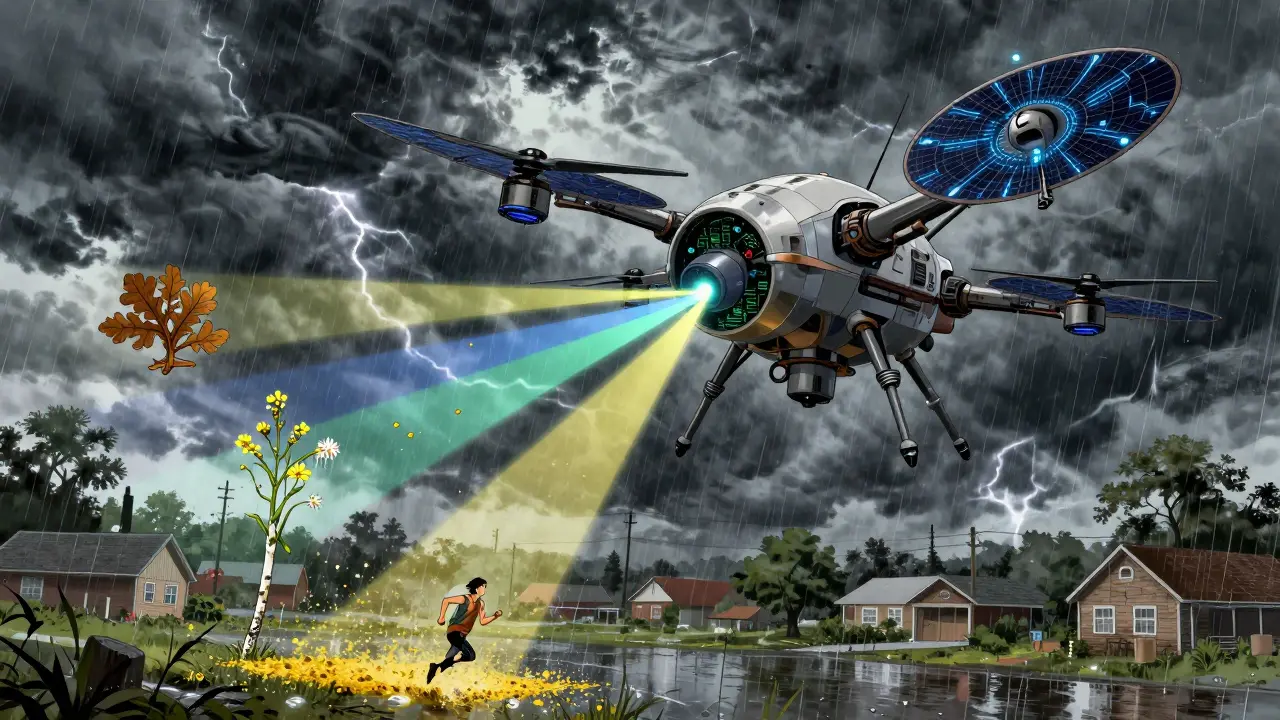
Thunderstorms are the wild card. In Melbourne, Australia, a 2016 storm caused pollen grains to rupture and release tiny particles that triggered severe asthma attacks in 8,500 people - even those who didn’t have asthma before. Forecasting systems still can’t predict these events reliably. If the sky looks dark and stormy, even if the pollen count says "low," it’s safer to stay inside.
Which Apps and Services Actually Work?
Not all pollen apps are created equal. Here’s what the data says:
| Service | Accuracy | Resolution | Forecast Range | Cost |
|---|---|---|---|---|
| BreezoMeter | 82% | 1.5 km | 5 days | Paid API ($0.0005/call) |
| Pollen.com | 75% | 10 km | 3 days | Free |
| CAMS (Europe) | 87% | Regional | 5 days | Free |
| WeatherBug | 78% | 5 km | 4 days | Free with ads |
BreezoMeter leads in accuracy and detail, especially for urban areas. Its 1.5 km resolution means it can tell you if pollen is high on your street but low two blocks away. Pollen.com is free and reliable for general planning, but it’s too broad - you might get a "high" alert for your whole county when your neighborhood is fine. CAMS is excellent for Europe, but doesn’t integrate with mobile apps. If you’re serious about avoiding symptoms, use two services: one for precision (BreezoMeter or WeatherBug), and one for backup (Pollen.com).
How to Use Forecasts Like a Pro
Knowing the numbers isn’t enough. You need a plan.
- Check forecasts daily - especially during peak season. A 2023 survey found 58% of users check pollen levels every day in spring and fall.
- Time your outdoor time - go out in the early morning or evening. Avoid midday, especially on dry, windy days.
- Use rain as your reset button - wait 2 hours after a shower before heading out. You’ll get the lowest counts.
- Track your symptoms - keep a simple log: "Today’s count was 320, I sneezed 12 times, took 1 antihistamine." Over time, you’ll learn your personal triggers.
- Don’t trust one source - cross-check at least two apps. A 2022 Reddit poll showed users who used multiple sources reported 42% fewer flare-ups.
Parents of kids with allergies have seen dramatic changes. One mother in Ohio told her school district about pollen forecasts - now, outdoor recess is moved indoors on high-count days. School districts in 22 U.S. states have adopted similar policies.

What’s Next for Pollen Forecasting?
The field is advancing fast. In 2025, the European Space Agency plans to launch PollenSat - a satellite designed to spot pollen types from space. That could mean global forecasts with real-time type identification. Meanwhile, Apple Health and BreezoMeter are teaming up to link pollen exposure with heart rate and breathing data. Imagine an app that says: "Your symptoms spiked yesterday because of 400 grains/m³ of ragweed - avoid the park today."
But the biggest driver? Climate change. Since 1990, the U.S. pollen season has grown by over 20 days, and pollen concentrations have risen by 21%. We’re not just dealing with longer seasons - we’re dealing with stronger ones. That means forecasts aren’t a luxury anymore. They’re essential.
What to Do When the Forecast Gets It Wrong
Even the best models can miss a local wind shift or a sudden burst from a nearby field. If you get caught outside on a high-pollen day:
- Go inside immediately - close windows and turn on AC.
- Shower and change clothes - pollen sticks to skin and hair.
- Use saline nasal rinse - it clears pollen from your nose better than antihistamines alone.
- Don’t panic - most symptoms fade within hours if you avoid further exposure.
And remember: pollen forecasts don’t replace medication. They help you use it smarter. If you’re on daily antihistamines, keep taking them. But if you’re using them only when symptoms hit, forecasts can help you cut usage by up to 63%.
What time of day has the lowest pollen count?
Pollen counts are usually lowest between 5 a.m. and 7 a.m. and again from 7 p.m. to 9 p.m. This is because wind is calmer, temperatures are cooler, and dew keeps pollen from becoming airborne. For most people, this window is the safest time for outdoor activities like walking, gardening, or exercising.
Can rain really lower pollen counts?
Yes, light to moderate rain (0.1 inch or more) can reduce pollen counts by 30% to 50% within two hours. Rain washes pollen out of the air and weighs it down. However, heavy rain or thunderstorms can sometimes break apart pollen grains and spread them more widely - so avoid going out during storms.
Why do pollen forecasts sometimes feel inaccurate?
Forecasting models rely on regional data, but pollen can vary drastically over short distances. A field 500 feet away might be releasing a ton of grass pollen while your backyard stays clean. Also, sudden wind shifts, local landscaping, or even mowing your lawn can spike counts beyond what the model predicts. That’s why tracking your own symptoms helps you learn your personal environment.
Do I need to pay for a pollen forecast app?
No - free apps like Pollen.com and WeatherBug give reliable general forecasts. Paid apps like BreezoMeter offer hyperlocal precision (1.5 km resolution) and longer forecasts (5 days), which are especially useful if you live in a city with high variation or have severe allergies. If you’re just trying to avoid the worst days, free apps are enough.
How far ahead can pollen be predicted?
Seasonal forecasts (when tree, grass, or weed pollen will start) can be accurate 4 to 6 weeks ahead, based on winter temperatures and plant growth cycles. Daily forecasts are reliable for 2 to 5 days ahead, with accuracy dropping from 85% for 24-hour forecasts to 65% for 72-hour forecasts. For planning trips or events, aim to check forecasts 2 to 3 days before.
Are pollen forecasts useful for children?
Yes - children with allergies benefit greatly. Schools in 22 U.S. districts now use pollen forecasts to schedule outdoor activities. Parents who track forecasts report 30% fewer allergy-related school absences. For kids, avoiding peak pollen hours helps them stay active, sleep better, and focus in class.


Philip Blankenship
February 18, 2026 AT 23:02Man, I never realized how much timing matters with pollen until I started tracking it like a weather nerd. I used to just throw on a hoodie and go for a run at noon, thinking I was being healthy. Turns out, I was basically inhaling a pollen smoothie. Now I hit the trail before 7 a.m. or after 8 p.m., and my sinuses are thanking me. It’s wild how something so simple can make such a difference. I even set a reminder on my phone now - "Pollen Alert: Stay Inside." It’s not glamorous, but it’s life-changing.
Also, rain? Absolute game-changer. I wait for that light shower like it’s a free spa day for my lungs. Two hours later? I’m outside gardening like a normal human being. No more sneezing fits in the middle of planting tomatoes. Honestly, if you’re allergic and not using forecasts, you’re leaving your quality of life on the table.
Liam Earney
February 19, 2026 AT 21:21Oh, absolutely-this is so important, I mean, really, it’s not just a suggestion, it’s a necessity, isn’t it? I mean, have you ever had one of those days where you’re just… suffocating? Like, your eyes are watering, your nose is running, your throat feels like it’s lined with sandpaper, and you’re wondering why you even left the house? And then you check the app-and it says "moderate"? Well, that’s because it’s not measuring the pollen that’s actually swirling around your driveway, is it? I mean, the model doesn’t know your neighbor’s got a 30-foot ragweed jungle behind his shed. So yes, cross-reference. Always. Please. For your sanity.
And thunderstorms? Oh, God, thunderstorms. I read about Melbourne. Eight thousand five hundred people. That’s not a statistic. That’s a tragedy. And yet, no one talks about it. Why? Because it’s inconvenient? Because it’s too scary? I mean, we have satellites now, we have algorithms, we have data-but we still treat pollen like it’s just "a little seasonal discomfort." It’s not. It’s a public health issue. And we’re ignoring it.
Brenda K. Wolfgram Moore
February 20, 2026 AT 06:00This is the kind of practical info that actually helps people. I’ve been using BreezoMeter and Pollen.com side by side for two years now, and the difference in accuracy is night and day. I used to think I was just "bad with allergies," but turns out I was just using bad data. Now I know exactly when to keep my windows shut, when to shower after being outside, and when to let the kids play in the yard without a tissue box nearby. My daughter’s school even started using the forecasts to move recess indoors-no more coughing fits during gym class. It’s small changes, but they add up. And yes, rain is magic. Always wait two hours. Always.
Sam Pearlman
February 21, 2026 AT 08:45Okay, but have you ever considered that maybe pollen forecasts are just corporate propaganda to sell you more antihistamines? I mean, who even decided that pollen counts are a thing we need to track? Big Pharma? The weather app companies? The same people who told us sunscreen was the answer to skin cancer? I’m not saying it’s fake-but I’m saying don’t trust the algorithm. I went outside on a "low" day last week, sneezed for an hour, and then checked the real-time sensor on my porch-it was spiking at 780. The app said 42. That’s not science. That’s a lie.
Also, why do we assume all pollen is bad? Maybe our bodies just need to adapt. Maybe we’re too clean. Maybe we’re allergic to modern life. Just saying.
Steph Carr
February 22, 2026 AT 18:06Let me get this straight: we’ve got satellite data, AI models, real-time sensor networks, and yet the average person still thinks "high pollen day" means "maybe don’t open the windows." Meanwhile, the same people who use these apps to avoid pollen are the ones who still mow their lawns at noon on a 90-degree day with a 12 mph wind. It’s like using a GPS to find the shortest route to the grocery store… then parking in the middle of the highway because "I’m in a hurry." I love that schools are using this info now. That’s progress. But we’re still treating allergies like a nuisance instead of a systemic issue. Climate change isn’t just melting glaciers-it’s making ragweed a superhero. And we’re still arguing about whether apps are "worth it."
Also, BreezoMeter’s 1.5 km resolution? That’s not precision. That’s a mercy.
Oliver Calvert
February 24, 2026 AT 10:15Grass pollen peaks midday, yes, but only if you're in a temperate zone. In the UK, the peak is often earlier-around 8am-because of our damp mornings and less intense sun. Also, tree pollen in Ireland is dominated by birch, not oak, so if you're using a US-based app, you're getting misleading data. I've been tracking this for 15 years. The key is local knowledge. Use the forecast as a guide, not a rule. And always shower after being outside. It's simple. It works.
Digital Raju Yadav
February 24, 2026 AT 14:24USA spends billions on pollen apps while India has 300 million people with untreated allergies and no access to clean air. You call this science? This is privilege. You track pollen like it’s a luxury sport. Meanwhile, my cousin in Delhi breathes through a cloth mask because the PM2.5 is 1200. You’re optimizing your sneezes while the planet burns. This isn’t innovation. It’s distraction.
Jonathan Ruth
February 24, 2026 AT 19:55Forecast accuracy drops after 72 hours? Yeah, no kidding. I checked the app for my trip next weekend and it said "low" for Saturday. Turned out a wildfire 30 miles away turned the whole valley into a smoke bomb. Pollen app didn’t even register it. You can’t predict everything. Sometimes you just gotta go with your gut. I learned that after my third ER visit. Also, no one talks about how car AC filters are trash. Change them. Every 3 months. It’s not hard.
Logan Hawker
February 25, 2026 AT 01:22While I appreciate the granular breakdown of pollen dynamics, I must point out that the entire framework is fundamentally anthropocentric. We treat pollen as a problem to be optimized rather than a natural ecological signal. The real issue isn’t the 500 grains per cubic meter-it’s the monoculture lawns, the urban heat islands, the systemic disregard for native flora. We’ve engineered an environment where ragweed thrives because we’ve destroyed biodiversity. The forecast doesn’t fix that. It just lets you avoid the symptoms while the root cause festers. Also, CAMS is superior. Why are we even discussing paid APIs? This is public good.
James Lloyd
February 26, 2026 AT 09:19I’ve been using pollen forecasts for 12 years. Started because I couldn’t sleep. Ended up redesigning my whole routine. I keep a little logbook-date, count, symptoms, meds. Over time, I noticed I react way worse to birch than oak. My city’s app didn’t even break it down by type. So I cross-referenced with CAMS and found out I live right under a birch-lined street. Moved my bedroom to the other side of the house. Changed my commute. Cut my antihistamine use in half. It’s not magic. It’s data. And yeah, rain is the best thing ever. I’ve started checking the radar like it’s a sports game. "Oh, 0.3 inches at 4 p.m.? Perfect. I’ll go for a walk at 6." Also-saline rinse. Do it. It’s not glamorous, but it’s the single most effective thing I’ve ever done.
Carrie Schluckbier
February 27, 2026 AT 05:16Wait-so you’re telling me the government and big tech are tracking pollen… but not the chemicals they spray on crops? Or the GMO plants they’re releasing? Or the fact that the EPA stopped monitoring airborne allergens in 2019? This isn’t about allergies. This is about control. They want you to think you’re safe if you use an app. But what about the 17 new allergens they’ve been quietly releasing since 2021? The ones that don’t show up on any forecast? They’re testing them on kids in schools. That’s why the asthma spikes. That’s why the pollen counts are rising. They’re not natural. They’re engineered. And you’re just checking your phone like a good little drone.
Agnes Miller
February 27, 2026 AT 22:11Just wanted to say I’ve been using Pollen.com for years and it’s been fine. I don’t need fancy apps. I just check it in the morning. If it’s high, I skip the yard work. If it’s low, I take the dog out. Simple. Also, I’m not great with tech-I keep misspelling "BreezoMeter" as "BreezoMeter"-but I get the gist. Rain helps. Wind makes it worse. My husband says I’m obsessed. I say I’m just trying to breathe. And honestly? I’m winning.
Geoff Forbes
February 28, 2026 AT 18:59Let’s be real-most of these "forecasts" are just glorified guesswork. I mean, who even measures pollen? Some guy with a greased rod? That’s not science. That’s 1950s science. And now we’re trusting our health to a model that can’t even tell if your backyard is full of weeds? I live in a suburb with 47 different types of trees. My app says "moderate." My nose says "emergency." I stopped trusting the numbers. Now I just wear a mask. Always. Even if it’s 40 degrees. Better safe than sneezing in public.
Tony Shuman
March 1, 2026 AT 07:55They say climate change is making pollen worse. But what if it’s not the climate? What if it’s the fact that we’ve been replacing native plants with invasive species for 50 years? What if the real issue is that we’ve turned every lawn into a monoculture of grass and dandelions? What if the pollen isn’t getting stronger-what if it’s just everywhere now because we’ve destroyed ecosystems? And yet, instead of fixing that, we just make better apps? We’re not solving the problem. We’re just giving people a way to avoid it. That’s not progress. That’s surrender.
John Haberstroh
March 2, 2026 AT 03:20One thing no one mentions: pollen doesn’t care about your schedule. I once followed the forecast religiously-low count, perfect day, went out at 6 a.m. to hike. Two hours in, I felt like I’d swallowed a cactus. Turned out a neighbor had just mowed their entire field of ragweed. The wind shifted. The app didn’t know. That’s the thing. Forecasts are great, but they’re not omniscient. Your own body? That’s the best sensor you’ve got. Learn your triggers. Notice patterns. Keep a journal. And don’t forget: pollen isn’t evil. It’s just trying to reproduce. We’re the ones who built our homes right next to its party.
Philip Blankenship
March 3, 2026 AT 01:57Just saw someone reply saying they moved their bedroom because of birch pollen. That’s next level. I’m still just hiding inside on Tuesdays. But now I get it. This isn’t about apps. It’s about tuning into your environment. Like listening to your body like it’s a radio station. You learn the static. You learn the signal. And eventually, you just… know. No app needed.