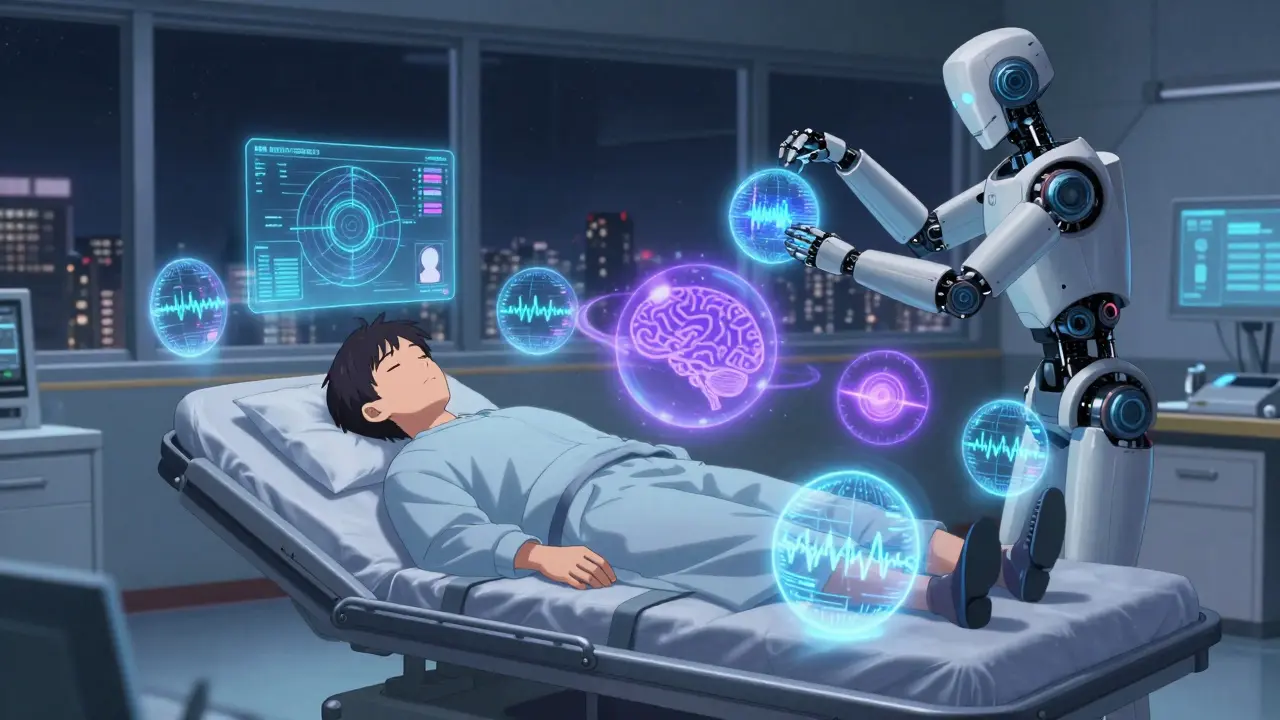
When you’re tossing and turning every night, waking up exhausted even after eight hours in bed, it’s easy to blame stress or age. But what if the real problem is hidden in your sleep cycles? That’s where polysomnography comes in - the most detailed sleep test doctors use to find out what’s really going on while you’re asleep.
What Exactly Is a Polysomnography?
Polysomnography, often called a sleep study, isn’t just about counting how many times you stop breathing. It’s a full-body monitoring session that tracks how your brain, heart, lungs, muscles, and eyes behave during sleep. The word itself breaks down to "many" (poly), "sleep" (somno), and "recording" (graphy) - and that’s exactly what it does. It records at least seven different signals all at once, giving doctors a complete picture of your sleep architecture. Unlike a simple home sleep test that only checks your breathing, polysomnography watches how you move through each stage of sleep - from light NREM sleep to deep sleep and REM, where dreaming happens. This matters because disorders like narcolepsy, restless legs syndrome, or REM sleep behavior disorder can’t be caught by breathing-only tests. You need the full set of data to see if your brain is switching sleep stages properly.What Happens During the Test?
You’ll arrive at a sleep center about an hour before your usual bedtime. The room looks like a hotel room - quiet, dim, with a comfortable bed. No hospital gowns or IVs. Just a technician attaching sensors to your scalp, face, chest, legs, and fingers. About 22 small electrodes and belts go on, but they’re not painful. Think of them like sticky patches with tiny wires. One sensor on your nose measures airflow. A belt around your chest tracks breathing effort. A clip on your finger checks your blood oxygen levels. Electrodes on your chin monitor muscle tone - if your legs jerk or your jaw clenches, it shows up. Eye movements are tracked too, because sudden eye flickers tell the system when you’ve entered REM sleep. And yes, there’s a camera and microphone in the room, just in case you talk, scream, or get out of bed during the night. The technician stays in an adjacent room, watching everything on monitors. If a sensor falls off, they’ll come in quietly to fix it. You can call out if you need the bathroom - the wires are long enough to let you move around. Most people find it awkward at first, but by the second hour, most fall asleep. Studies show over 85% of patients get enough sleep for a valid diagnosis, even with all the equipment on.What Does the Data Show?
After the night ends, a sleep specialist spends 2-3 hours reviewing the data. Each minute of sleep is scored by hand or with AI-assisted tools. The report breaks down:- How long it took you to fall asleep (sleep latency)
- How many times you woke up during the night (arousals)
- How much time you spent in each sleep stage - especially REM
- How many breathing pauses you had per hour (the Apnea-Hypopnea Index or AHI)
- Whether your oxygen dropped below 90% during those pauses
- If your legs kicked or moved abnormally
- If you acted out dreams (REM behavior disorder)
Polysomnography vs. Home Sleep Tests
Home sleep tests are cheaper and more convenient. But they only measure three to four things: airflow, oxygen, breathing effort, and heart rate. They’re great for spotting clear-cut sleep apnea in people with loud snoring and daytime fatigue. But if you have other symptoms - like sudden sleep attacks, leg jerks, or nighttime confusion - a home test won’t catch it. In-lab polysomnography catches things home tests miss:- Narcolepsy (abnormal REM timing)
- Periodic limb movement disorder
- Parasomnias (sleepwalking, night terrors)
- Central sleep apnea (where your brain stops sending breathing signals)
- Seizures during sleep
Split-Night Studies: Diagnosis and Treatment in One Night
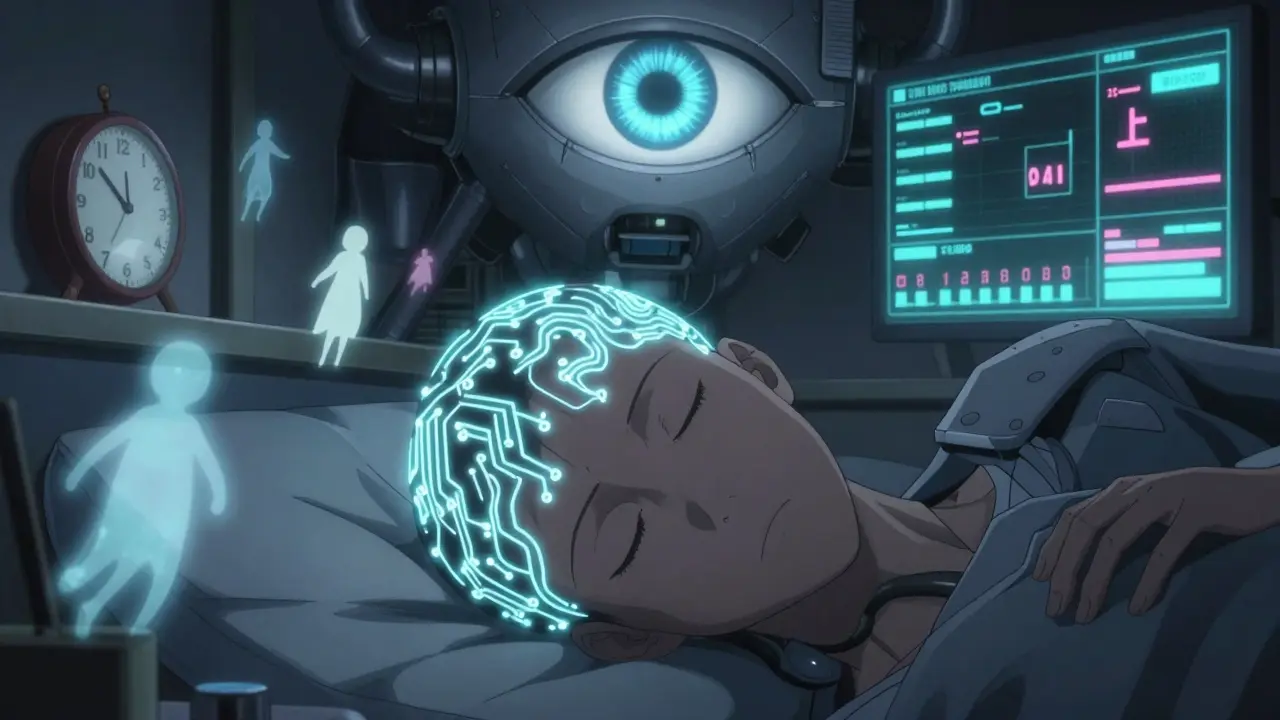
If your sleep study shows severe sleep apnea - say, over 30 breathing pauses per hour - the technician might switch you to a CPAP machine during the second half of the night. This is called a split-night study. The first half diagnoses the problem. The second half finds the right air pressure to keep your airway open. About 35% of polysomnography studies today are split-night. It saves time, money, and the stress of returning for a second test. But it only works if the apnea is obvious early on. If your breathing is borderline, you’ll need a full diagnostic night first.How to Prepare for Your Sleep Study
You don’t need to fast or change your diet. But here’s what actually helps:- Stick to your normal sleep schedule for at least 3 days before the test
- Avoid caffeine after noon - that includes coffee, tea, soda, and chocolate
- Don’t nap in the afternoon
- Wash your hair before you go - no conditioners or oils, they interfere with sensors
- Bring your own pillow, pajamas, and anything that helps you sleep
What the Results Mean for Your Health
The report will give you a diagnosis - and a plan. If it’s sleep apnea, you’ll likely get a CPAP machine. If it’s narcolepsy, you might start on stimulants or sodium oxybate. For restless legs, iron supplements or dopamine meds help. For sleepwalking or night terrors, safety tips and sometimes medication are recommended. But here’s the key: the results don’t just say "you have sleep apnea." They tell you how bad it is, when it happens, and what triggers it. Did it only happen when you slept on your back? Did your oxygen drop more during REM? That info helps your doctor fine-tune your treatment.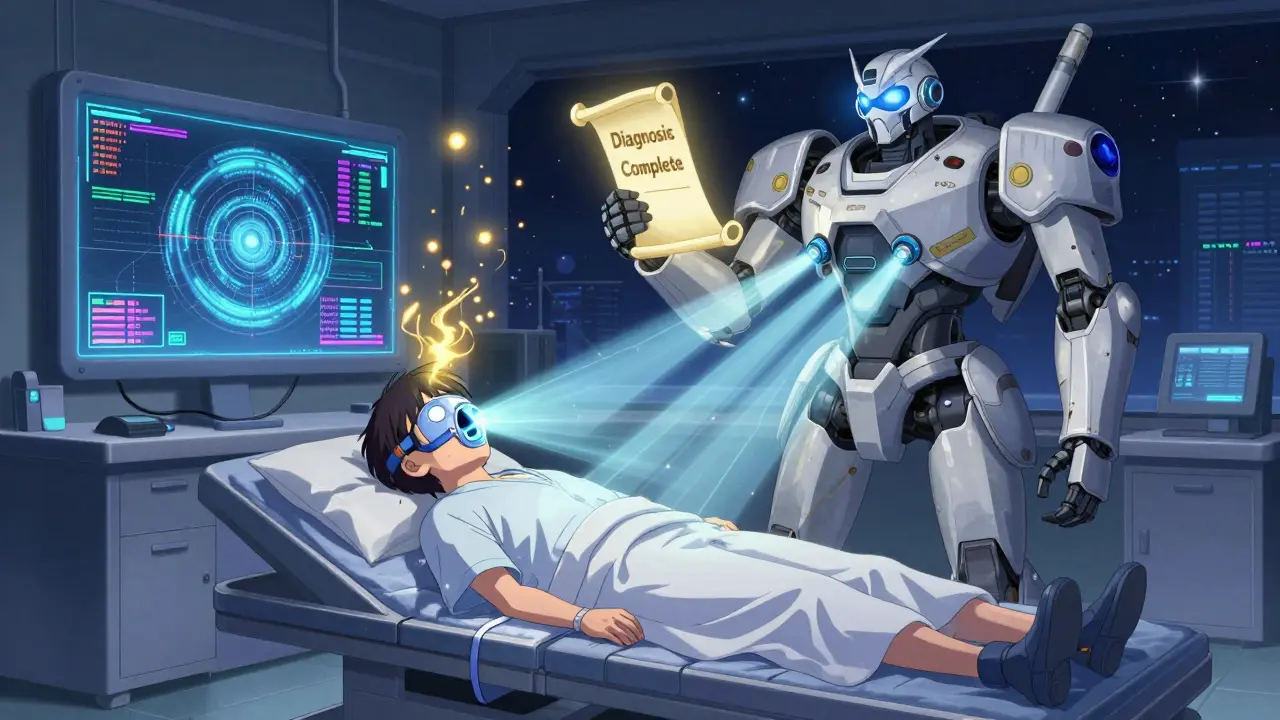
Is It Worth It?
Insurance usually covers polysomnography if your symptoms match Medicare or AASM guidelines - loud snoring, witnessed apneas, excessive daytime sleepiness, or high blood pressure with unexplained fatigue. Medicare pays about 80%, and most private insurers follow suit. You’ll likely pay a copay, but not the full $1,500-$3,000 cost. Patient satisfaction is high - over 90% - when they understand what to expect. People who get treated after a sleep study often say they feel like they’ve been given their life back. Better focus. Less irritability. No more napping on the couch after dinner.What’s New in Sleep Studies?
New wireless sensors are cutting the number of wires from 20 down to 5-7. Some labs now use AI to flag abnormal patterns faster. Video-EEG monitoring is being used more for seizures disguised as sleep disorders. And researchers are testing simplified at-home polysomnography - but so far, it’s not as accurate as the in-lab version. The American Academy of Sleep Medicine says polysomnography will remain the gold standard through at least 2030. Why? Because sleep isn’t just about breathing. It’s about how your brain wakes up, how your body relaxes, and how your body reacts when something goes wrong. Only a full polysomnography can see all of that.Is a polysomnography painful?
No, it’s not painful. The sensors are sticky patches with thin wires - like a heart monitor at the hospital. You might feel slight pressure from the chest belt or a small clip on your finger, but nothing sharp or invasive. Most people say the biggest challenge is falling asleep in a new environment, not the equipment.
Can I sleep normally with all those sensors on?
Yes, most people do. The sensors are designed to be lightweight and flexible. Even if you toss and turn, the wires are long enough to let you move. Technicians monitor your sleep in real time and can adjust sensors if needed. About 85% of patients get enough sleep for a valid diagnosis, even with the equipment. Bringing your own pillow and wearing familiar pajamas helps a lot.
How long does it take to get results?
It usually takes 1-2 weeks. The sleep study generates over 1,000 pages of raw data. A board-certified sleep physician reviews every minute of your sleep, scoring brain waves, breathing events, leg movements, and sleep stages. Once the report is complete, your doctor will schedule a follow-up to explain the findings and next steps.
Can polysomnography detect narcolepsy?
Yes, it’s one of the main tools. Narcolepsy often shows up as entering REM sleep too quickly - sometimes within 10 minutes of falling asleep, instead of the normal 90 minutes. A polysomnography is usually followed by a Multiple Sleep Latency Test (MSLT) the next day to confirm the diagnosis, but the overnight study is the first critical step.
What if I have to use the bathroom during the study?
You can get up anytime. The wires are long enough to let you walk to the bathroom. Just press the call button, and a technician will come in to help you disconnect the main cable. It’s completely normal - many people do it. The technician will reconnect everything quickly and quietly.
Are home sleep tests just as good?
No, not for everyone. Home tests only measure breathing and oxygen - they can’t detect narcolepsy, sleepwalking, leg jerks, or central sleep apnea. They also fail 15-20% of the time because sensors fall off. If your symptoms are complex, or if a home test was negative but you still feel exhausted, your doctor will likely recommend an in-lab polysomnography.
Does insurance cover polysomnography?
Yes, most insurance plans, including Medicare, cover it if you have symptoms like loud snoring, witnessed breathing pauses, or excessive daytime sleepiness. Medicare pays about 80%, and private insurers usually require a prior authorization based on your doctor’s notes. Check with your provider, but coverage is common when the test is medically necessary.

Kevin Lopez
December 30, 2025 AT 03:30APS-2023 guidelines are clear: if AHI >15 + EDS, polysomnography is mandatory. Home tests are for screening only - not diagnostics. Don’t confuse sensitivity with specificity.
EEG, EMG, EOG, ECG, airflow, SpO2, chest/abdominal effort - that’s the gold standard. Skip the shortcuts.
Periodic limb movement index? Only polysomnography catches it. Home test? Nope.
REM sleep without atonia? That’s RBD. Home test can’t detect it.
Central apneas? No respiratory effort = invisible on home devices.
And don’t even get me started on narcolepsy. SOREMPs are the tell. You need full sleep architecture.
Bottom line: if you’re not getting a full PSG, you’re gambling with your neurology.
Insurance will cover it if you have the right ICD-10 codes. Don’t let them lowball you.
Duncan Careless
December 31, 2025 AT 00:03honestly i was terrified before my study… thought it’d be like a hospital nightmare with wires everywhere.
turns out the room was cozy, the tech was chill, and i actually slept better than i have in months.
they even let me bring my own pillow 😅
the only weird part? hearing myself snore on the recording later… yikes.
but worth it. got diagnosed with mild OSA and now i’m on cpap. life changed.
if you’re hesitating - just do it. no regrets.
Russell Thomas
December 31, 2025 AT 17:53Oh wow, so you’re telling me the $3,000 sleep lab is just a glorified Netflix-and-chill-with-wires experience?
And we’re supposed to be impressed that they ‘watch you sleep’ like it’s a reality show?
Meanwhile, my Fitbit tells me I had 7 hours of ‘deep sleep’ and I’m still waking up like a zombie.
So what’s the real difference? You pay $3k to be told what your $200 wearable already guessed?
And the ‘AI-assisted tools’? More like a sleep doc squinting at graphs at 2 a.m. while drinking cold coffee.
It’s not science - it’s theater. With electrodes.
PS: ‘Split-night studies’? Sounds like a bad episode of House M.D.
PPS: I’m still not convinced this isn’t just a money grab disguised as medicine.
Joe Kwon
January 1, 2026 AT 16:25Really appreciate this breakdown - especially the part about SOREMPs and RBD. I’ve been dealing with unexplained daytime fatigue for years, and my PCP wanted to just give me melatonin.
Thankfully, I pushed for a PSG after reading about REM atonia loss. Turns out I have RBD - no one saw it coming.
The sensors? Totally manageable. I brought my own blanket and slept better than I have since college.
Biggest takeaway? Sleep isn’t passive. It’s a complex neurophysiological ballet. And PSG is the only way to see the choreography.
Also, if you’re on CPAP and still tired? Go back. Pressure might need tweaking. Don’t settle.
And yes - bring your own pillow. It’s not weird. It’s science.
🙏
Jasmine Yule
January 2, 2026 AT 10:28I just want to say thank you to whoever wrote this. I’ve been too scared to get tested because I thought it’d be invasive or embarrassing.
But reading this made me feel seen - like someone finally explained what’s happening to my body without making me feel broken.
I’m scheduling my PSG next week. I’m nervous, but… hopeful.
Thank you for not just listing facts - you made it human.
💖
Greg Quinn
January 3, 2026 AT 04:42It’s funny how we treat sleep like a black box - something we just ‘do’ without thinking about it.
But the brain during sleep is more active than during waking hours - just in different patterns.
Polysomnography doesn’t just diagnose disorders. It reveals the architecture of our unconscious.
Every micro-arousal, every REM burst, every limb jerk - it’s a whisper from the autonomic nervous system.
We’ve outsourced our rest to algorithms and gadgets, but the body remembers what it truly needs.
Maybe the real question isn’t ‘what’s wrong with my sleep?’
But ‘what’s wrong with the way we live that makes sleep so broken?’
PSG is the mirror. The cure? That’s up to us.
Nisha Marwaha
January 4, 2026 AT 13:12As a sleep tech in Mumbai, I’ve seen this firsthand - families in rural India think sleep apnea is just ‘snoring too loud.’
They don’t know about central apneas, or how hypoxia damages the hippocampus over time.
PSG is expensive here, but NGOs are starting to fund mobile sleep labs.
One woman came in thinking she had ‘night demons’ - turned out she had RBD and was punching her husband.
She cried when she saw the video playback. ‘So it wasn’t the ghosts?’
Knowledge saves lives. Even in places where sleep medicine is still a luxury.
Keep spreading awareness. This isn’t just Western medicine - it’s human biology.
Paige Shipe
January 4, 2026 AT 16:34So you're telling me I need to spend $3000 to find out why I'm tired? And I have to sleep in a weird room with wires on my head while strangers watch me?
Meanwhile, my cousin just bought a $50 sleep tracker on Amazon and says he's 'optimized his REM cycles'.
And you want me to believe that a lab with 22 electrodes is more accurate than AI that analyzes my phone's motion data?
Also, why do they need to record me screaming in my sleep? Is that for insurance fraud detection?
And 'no conditioners'? What is this, a science fair? I'm not a lab rat.
Also - I'm not paying $3000 to be told I have sleep apnea. I already know. I snore like a chainsaw.
PS: My doctor said 'maybe try CPAP' - I said 'maybe try sleeping on my side' - I'm still alive. So maybe I don't need all this?
Tamar Dunlop
January 6, 2026 AT 04:33As a Canadian physician who has trained in both urban and remote clinics, I can attest to the profound dignity inherent in this diagnostic process.
It is not merely a clinical procedure - it is a sacred act of listening to the body’s silent language.
In our northern communities, where sleep disorders are tragically underdiagnosed due to geographic isolation, the arrival of a mobile PSG unit is nothing short of transformative.
One elderly Inuit patient, after years of being told she was ‘just tired from aging,’ was diagnosed with severe OSA - and within two weeks of CPAP initiation, she danced at her granddaughter’s wedding for the first time in a decade.
Let us not reduce this to cost-benefit analysis.
It is, at its core, an act of compassion encoded in electrodes and algorithms.
Thank you for honoring the quiet science of sleep.
David Chase
January 7, 2026 AT 13:49OMG YES!!! 😤🔥
My cousin got a home test - NEGATIVE. He was still collapsing at work. I told him to push for PSG. He did. Turns out - CENTRAL APNEA. Brain wasn’t telling his lungs to breathe. Home test missed it 100%.
AND - he was having seizures disguised as sleepwalking. 😱
PSG caught it. Neurologist said if he hadn’t gotten tested, he’d have died in his sleep.
So yeah - if you’re tired, snoring, or just feel ‘off’ - DON’T BE A COWARD.
PSG isn’t expensive - it’s LIFE-SAVING.
Also - stop using sleep trackers. They’re toys. This is MEDICINE.
🇺🇸💪 #SleepIsNotOptional #PSGisLife
Emma Duquemin
January 8, 2026 AT 15:53Y’all. I went in thinking I had sleep apnea. Came out with narcolepsy + RBD + low iron. Three diagnoses in one night.
Turns out my ‘weird dreams’ where I punched my husband? That was REM atonia failure.
My ‘random daytime naps’? SOREMPs. I was falling into REM in 8 minutes.
They gave me modafinil. I haven’t napped on the couch since. I’m back to hiking, cooking, and actually enjoying coffee.
And yeah - the wires? Weird at first. But the techs were angels. They brought me tea. I cried when I saw my sleep graph.
It’s not just a test. It’s a reunion with your own body.
Do it. Even if you’re scared. Even if you think it’s ‘not that bad.’
You’ll thank yourself in 6 months.
✨