
Vilazodone Diarrhea Management Calculator
Personalized Guidance
This calculator uses clinical data to estimate your diarrhea resolution timeline and provide tailored management recommendations based on your current situation.
Starting vilazodone (Viibryd) for depression can feel like a step forward - but for nearly 1 in 3 people, it comes with a side effect that’s hard to ignore: diarrhea. It’s not rare. It’s not mild. And for many, it’s the reason they consider quitting before the medication even has a chance to work. The good news? Most cases fade within two weeks. The better news? There are clear, science-backed ways to reduce it - and keep taking the drug if it’s right for you.
Why Vilazodone Causes Diarrhea
Vilazodone works differently than most antidepressants. It’s not just a serotonin reuptake inhibitor like SSRIs. It’s a SPARI - a serotonin partial agonist and reuptake inhibitor. That means it doesn’t just block serotonin from being reabsorbed; it also gently activates certain serotonin receptors in the brain and gut. This dual action helps improve mood, but it also overstimulates nerves in the intestines, leading to faster movement of food and water - which is exactly what causes diarrhea. Clinical trials show that 26% to 29% of people taking vilazodone at the standard 40 mg daily dose experience diarrhea. That’s nearly three times higher than the 10% seen in placebo groups. Compare that to sertraline (18%) or escitalopram (6%), and vilazodone stands out - not for being more effective, but for being harder on the stomach. The timing matters, too. Most people notice symptoms within the first week. The median duration? Seven days. By two weeks, over 94% of cases are mild or moderate, and the majority have resolved on their own. But if diarrhea sticks around past 14 days, it’s not normal. It’s a sign you need to adjust your approach.How to Take Vilazodone to Minimize Diarrhea
The biggest mistake people make? Taking vilazodone on an empty stomach. The FDA labeling is clear: you must take it with food - at least 500 calories. That’s not a suggestion. It’s a requirement. Why? Without food, vilazodone’s absorption drops sharply. With it, bioavailability increases by 60%. But more importantly, food slows gastric emptying. That means the drug enters your system more gradually, reducing the sudden spike in serotonin that triggers gut spasms and loose stools. Your meal doesn’t need to be fancy. A sandwich with turkey and cheese, a bowl of oatmeal with peanut butter and banana, or grilled chicken with brown rice and broccoli all work. Avoid fast food, greasy meals, or sugary snacks. They won’t help - and might make things worse.Dosing Strategy: Go Slow, Not Fast
Doctors often start patients at 10 mg daily for a week, then bump to 20 mg for another week, and finally to 40 mg. This isn’t just about safety - it’s about side effect control. Jumping straight to 40 mg? You’re more likely to get severe diarrhea. Slowing the titration gives your gut time to adapt. In fact, a 2023 study from the Psychopharmacology Institute found that patients who followed the full 14-day titration schedule had a 35% lower rate of diarrhea than those who rushed to the full dose. If you’re still having trouble after two weeks at 20 mg, don’t force it. Talk to your doctor about staying at 20 mg for longer. Many people find 20 mg is enough to lift their mood without the GI trouble. You don’t need 40 mg to benefit.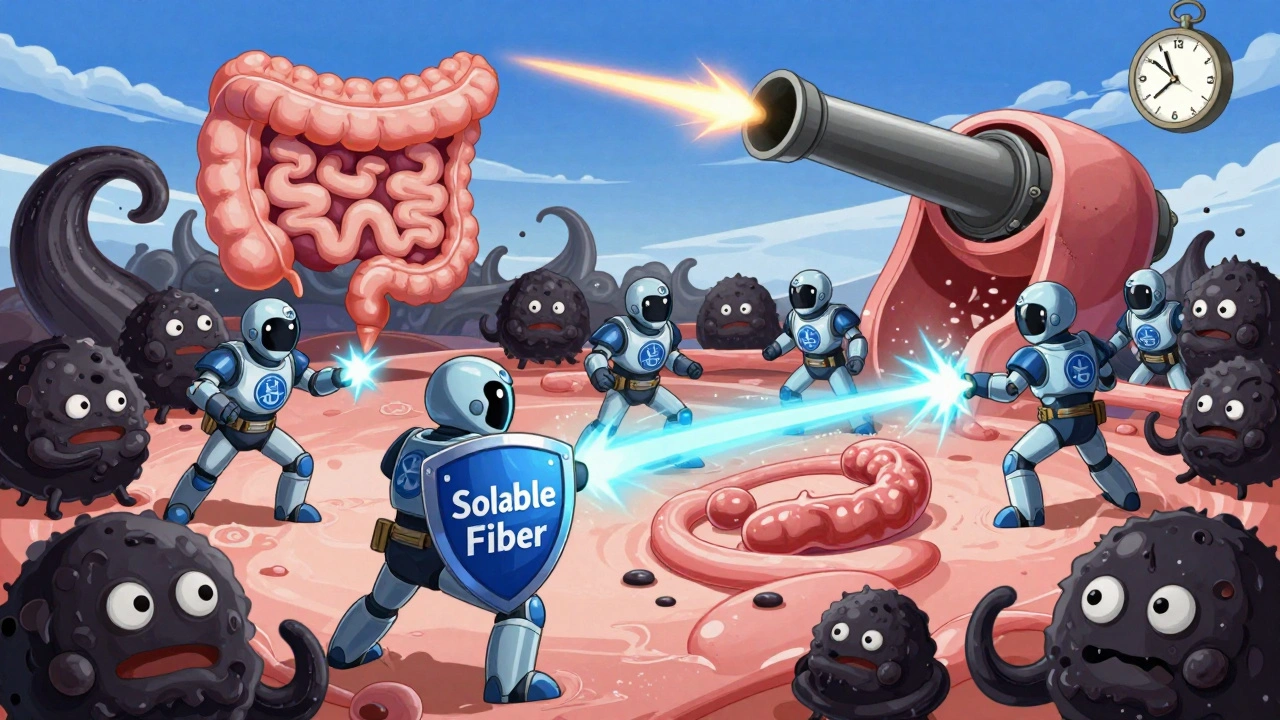
What to Eat - and What to Avoid
Diet changes are one of the most effective, underused tools for managing vilazodone-induced diarrhea. Do:- Take in 10-15 grams of soluble fiber daily - oats, apples, bananas, psyllium husk, and chia seeds help bind stool.
- Use probiotics. The 2023 VIVALDI study showed that taking a daily probiotic with Bifidobacterium longum cut diarrhea rates from 28% to 15% over eight weeks.
- Drink plenty of water. Diarrhea dehydrates you fast. Aim for at least 8 cups a day.
- Caffeine - coffee, tea, energy drinks. It speeds up your colon.
- Artificial sweeteners - sorbitol, mannitol, xylitol. Found in sugar-free gum and diet sodas, they’re notorious for causing loose stools.
- Spicy, fried, or fatty foods. They irritate the gut and worsen motility.
- Alcohol. It dehydrates you and messes with serotonin levels.
When to Use Loperamide (Imodium)
If diarrhea is disrupting your day - affecting work, sleep, or social life - loperamide (Imodium A-D) is a safe, short-term option. Take 2 mg after the first loose stool, then 1 mg after each additional loose stool. Do not exceed 8 mg in 24 hours. Most people only need it for 3-5 days. It doesn’t treat the cause, but it gives your body time to adjust. Important: Never use loperamide if you have a fever, bloody stool, or severe abdominal pain. Those are red flags for infection or something more serious. Call your doctor immediately.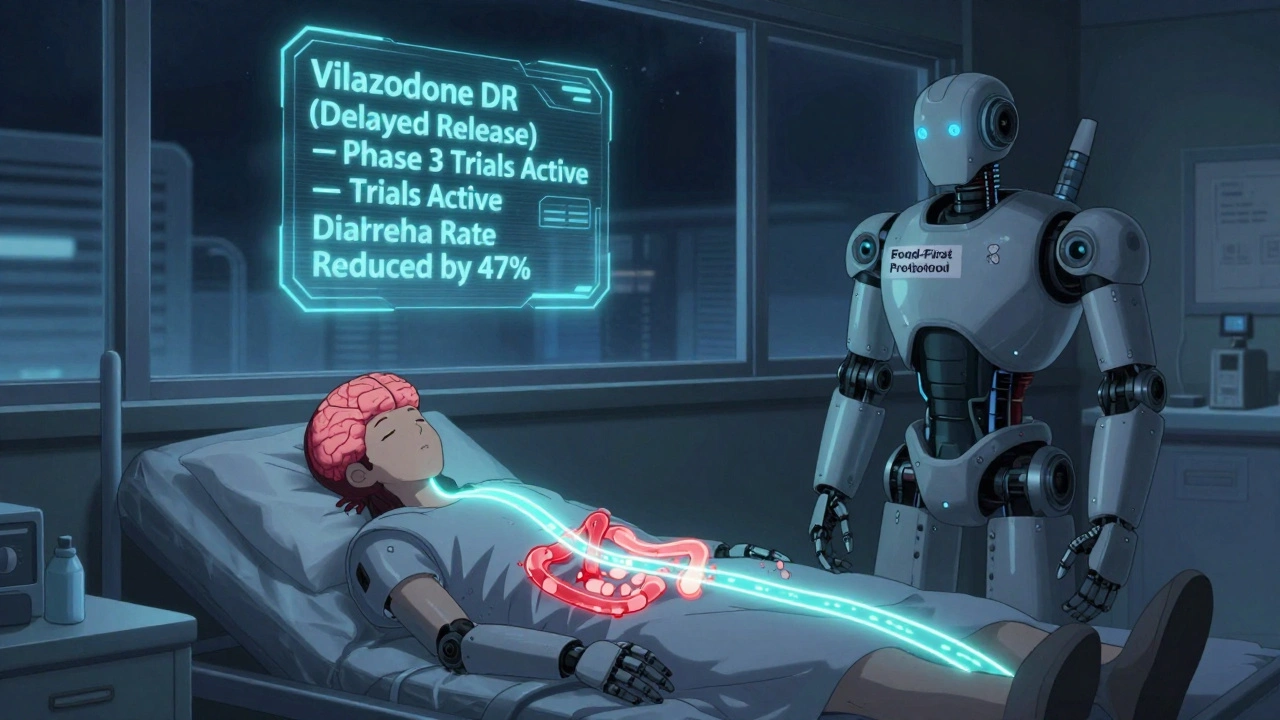
When to Stop Vilazodone
Most people get through the first two weeks. But if diarrhea continues beyond 14 days, gets worse, or is accompanied by cramping, fever, or weight loss, it’s time to reassess. About 10% of patients discontinue vilazodone because of persistent diarrhea. That’s not failure. It’s smart self-care. If you’ve tried the diet, the food, the slow titration, and the probiotics - and it’s still wrecking your life - switching to another antidepressant is a valid option. Bupropion (Wellbutrin) and vortioxetine (Trintellix) are two alternatives with much lower diarrhea rates. One patient on Reddit wrote: “After 3 weeks of constant diarrhea and cramping, my doctor switched me to bupropion - life changing.”Why Vilazodone Still Has a Place
It’s not the easiest antidepressant to tolerate. But it’s not useless. For people who’ve tried multiple SSRIs and SNRIs and struggled with sexual side effects - low libido, delayed orgasm, erectile dysfunction - vilazodone is a rare bright spot. Only 2-3% of users report sexual problems, compared to 25-70% with other drugs. It also doesn’t cause weight gain like mirtazapine or paroxetine. If you’re trying to avoid those side effects, vilazodone can be worth the GI hassle - if you manage it right. The fact that generic versions became available in late 2022 means more people are trying it. And with better education on how to handle the side effects, more are sticking with it. The market share is still small - just 1.2% in 2022 - but it’s growing.What’s Next for Vilazodone?
Researchers are already working on a delayed-release version of vilazodone (currently in Phase 3 trials) designed to release the drug more slowly in the gut. Early results suggest it could cut diarrhea rates by nearly half. If approved, it could make vilazodone a first-line option instead of a backup. In the meantime, the best tool you have is knowledge. You don’t have to suffer through diarrhea to get better. You don’t have to quit. You just need to know how to take it - and when to ask for help.Does vilazodone diarrhea go away on its own?
Yes, in most cases. About 94% of people who experience diarrhea while taking vilazodone find it resolves within 1 to 2 weeks without any changes to their treatment. It’s typically mild to moderate and linked to the body adjusting to the medication’s effect on serotonin in the gut.
Can I take Imodium with vilazodone?
Yes, loperamide (Imodium A-D) is generally safe to use short-term with vilazodone. Take 2 mg after the first loose stool, then 1 mg after each additional loose stool - but never more than 8 mg in 24 hours. Use it only for a few days to get through the worst of the symptoms. Avoid it if you have fever, bloody stools, or severe pain.
Should I take vilazodone with food?
Absolutely. You must take vilazodone with at least 500 calories of food. Without food, your body absorbs less of the drug and you’re far more likely to get diarrhea. A balanced meal with protein and complex carbs - like chicken and rice or a peanut butter sandwich - helps slow absorption and reduces side effects by up to 35%.
Is vilazodone better than other antidepressants?
It depends on what side effects matter most to you. Vilazodone has higher rates of diarrhea than most SSRIs, but much lower rates of sexual dysfunction and weight gain. If you’ve struggled with low libido or weight gain on other antidepressants, vilazodone may be worth trying - if you’re willing to manage the GI side effects with food, fiber, and slow dosing.
What should I do if diarrhea lasts longer than two weeks?
If diarrhea continues past 14 days, contact your doctor. Persistent diarrhea could mean your body isn’t adapting, or there’s another cause like an infection or food intolerance. Your doctor may suggest switching to another antidepressant like bupropion or vortioxetine, which have much lower rates of gastrointestinal side effects.
Do probiotics help with vilazodone-induced diarrhea?
Yes. A 2023 clinical trial showed that taking a daily probiotic containing Bifidobacterium longum reduced diarrhea incidence from 28% to 15% over eight weeks. Look for a supplement with at least 10 billion CFUs and that includes this strain. It’s not a cure, but it significantly improves tolerance.


Gillian Watson
December 5, 2025 AT 11:35Been on vilazodone for 6 weeks now. Diarrhea was brutal week 1-2, but taking it with a big breakfast (eggs, toast, avocado) made all the difference. No Imodium needed after day 10. Food isn't optional, it's medicine.
Martyn Stuart
December 6, 2025 AT 19:37Let me be perfectly clear: taking vilazodone without food is like lighting a firecracker in your gut. The FDA didn't put that 500-calorie requirement in there as a suggestion-it's a clinical necessity. I've seen patients self-sabotage for weeks because they thought 'a banana counts.' It doesn't. Not even close.
Chase Brittingham
December 7, 2025 AT 00:20My therapist told me to stick with it. I did. Two weeks in, I was ready to quit. Then I started eating oatmeal with peanut butter every morning. Poof. Diarrhea vanished. No magic. Just science.
Yasmine Hajar
December 7, 2025 AT 16:13Y’all are making this sound like it’s a personal failure if you get diarrhea. It’s not. It’s a biological response to a drug that hits serotonin receptors in your gut like a jackhammer. You’re not weak. You’re just human. And if you need Imodium for 3 days to get through work? Good for you. That’s self-care, not weakness.
Karl Barrett
December 8, 2025 AT 00:52From a neurogastroenterological perspective, the SPARI mechanism induces a paradoxical serotonergic cascade in the ENS-enteric nervous system-which directly modulates peristalsis and fluid secretion. The 26-29% incidence isn’t just statistical noise; it’s a predictable pharmacodynamic outcome of 5-HT1A partial agonism in the myenteric plexus. Food intake attenuates this by delaying gastric emptying and reducing peak plasma concentration. Probiotics? Bifidobacterium longum modulates gut-brain axis signaling via SCFA production and vagal afferent dampening. It’s not anecdotal-it’s mechanistic.
Bill Wolfe
December 8, 2025 AT 18:47Wow. So many people treat this like it’s a diet problem. 😒 Honestly, if you can’t handle a little diarrhea while getting your depression under control, maybe you’re not ready for real mental health work. I took it on an empty stomach for 5 days just to prove I could. I didn’t die. I just got a new appreciation for my colon. 🤷♂️
Jake Deeds
December 9, 2025 AT 13:19They say ‘it goes away in two weeks’ like that’s supposed to comfort us. Two weeks of waking up soaked in sweat, sprinting to the bathroom, and crying because you missed your Zoom meeting? That’s not ‘adjusting.’ That’s torture. And now I’m supposed to feel guilty for switching to bupropion? Nope. I’m not a lab rat. 😔
Carolyn Ford
December 10, 2025 AT 08:52Wait… you’re telling me that a drug company knew this would happen, and they still made people take it without food? And then they put it in the label in tiny print? That’s not negligence-that’s predatory. I’ve seen patients lose jobs because of this. Someone should sue. Someone should burn it all down. 🔥
Jenny Rogers
December 10, 2025 AT 19:10It is imperative to underscore that the pharmacokinetic profile of vilazodone is contingent upon the presence of a substantial caloric load. Failure to comply with this criterion constitutes a deviation from the approved therapeutic protocol and may result in suboptimal clinical outcomes, compounded by avoidable gastrointestinal distress. One must adhere to the regimen with the precision of a surgeon.
Rudy Van den Boogaert
December 11, 2025 AT 13:58My doctor told me to go to 40mg fast. I did. Got diarrhea for 10 days. Then I dropped to 20mg and kept it there. Mood’s still good. No more bathroom emergencies. Who says you need the max dose? Not me.
michael booth
December 13, 2025 AT 05:10Probiotics. Bifidobacterium longum. 10 billion CFUs. Daily. Not optional. I tried everything else. This was the one thing that made the difference. My gut stopped screaming. My brain started healing. I’m not a scientist. But I’m alive. And that counts.
Augusta Barlow
December 15, 2025 AT 01:40Did you know vilazodone was originally designed as a weight-loss drug? The diarrhea was so bad they pivoted to depression. Big Pharma doesn’t care if you’re miserable for two weeks-they just want you to stay on it. And now they’re making a slow-release version? Of course they are. They’re not fixing the problem. They’re monetizing it.
val kendra
December 15, 2025 AT 09:36Just want to say-this thread saved me. I was about to quit. Took it with a peanut butter sandwich. Added psyllium husk. Probiotic. Day 5 now. Only one loose stool. I’m not cured. But I’m hopeful. Thank you.
Bill Wolfe
December 16, 2025 AT 15:35Wow. So many people treat this like it’s a diet problem. 😒 Honestly, if you can’t handle a little diarrhea while getting your depression under control, maybe you’re not ready for real mental health work. I took it on an empty stomach for 5 days just to prove I could. I didn’t die. I just got a new appreciation for my colon. 🤷♂️
Also, @Gillian Watson-yes, the ‘chill observer’-you’re right. This isn’t about willpower. But I’m not sorry for saying it. Some people need to be shaken out of their denial.