
Why documenting generic drug substitutions matters more than you think
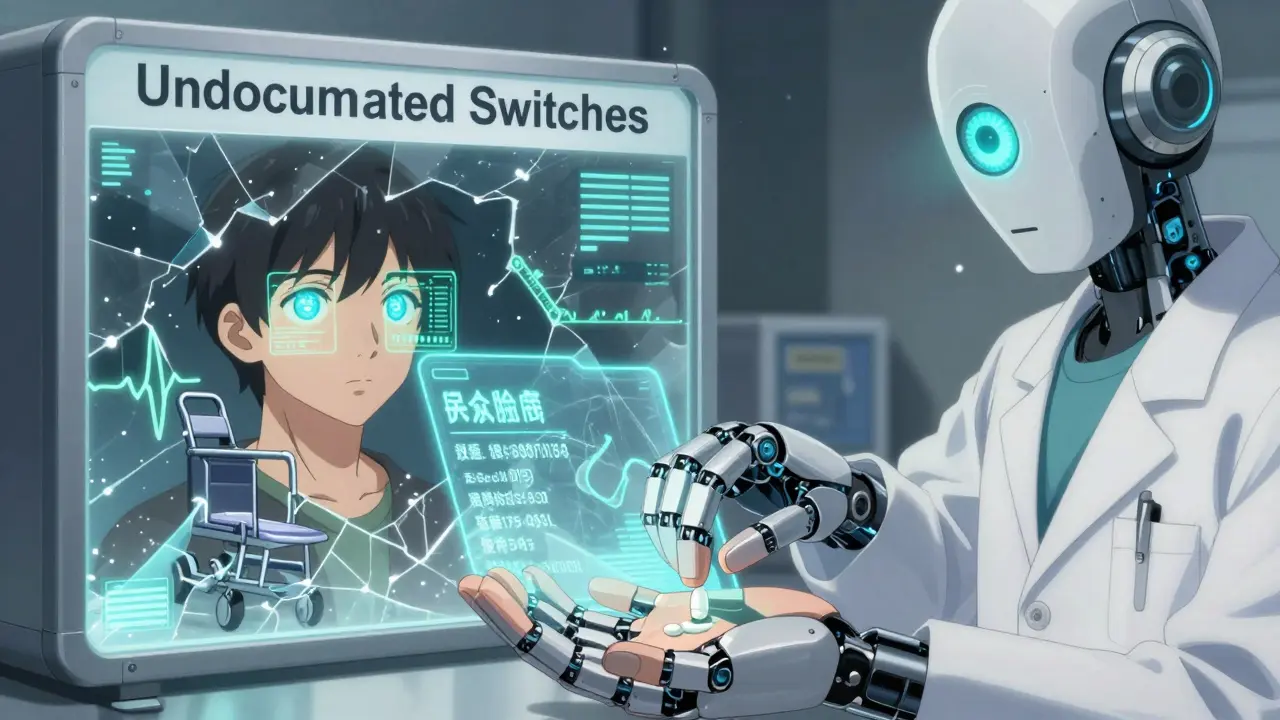
Every time a pharmacist swaps a brand-name pill for a cheaper generic, they’re making a clinical decision - not just a cost-saving one. And if that swap isn’t properly recorded, it could lead to serious harm. A patient on warfarin might end up in the hospital because their INR levels spiked after an undocumented switch to a different generic manufacturer. That’s not hypothetical. It happened in 2021, and it was traced back to missing documentation.
Generic drugs aren’t just cheaper versions of brand-name meds. They’re legally required to be bioequivalent - meaning they deliver the same active ingredient at the same rate and amount. But bioequivalence doesn’t always mean therapeutic equivalence in practice. Small differences in fillers, coatings, or release mechanisms can affect how a drug behaves in someone’s body, especially with narrow therapeutic index (NTI) drugs like levothyroxine, digoxin, or phenytoin. That’s why documentation isn’t just paperwork. It’s a safety net.
What exactly must pharmacists document?
In 48 out of 50 U.S. states, pharmacists are required to record specific details every time they substitute a generic drug. The core data points are non-negotiable:
- The brand name prescribed by the doctor
- The generic name dispensed
- The manufacturer of the generic product
- The lot number and expiration date
These aren’t arbitrary fields. They’re critical for tracing adverse reactions. If a patient has a bad reaction to a specific batch of generic metformin, the lot number lets pharmacists and regulators pull that entire batch from shelves. Without it, you’re flying blind.
Some states go further. Oklahoma requires explicit written consent from the patient or prescriber before any substitution. California, as of January 1, 2024, mandates real-time electronic documentation that prescribers can see instantly through their EHR systems. In states like New York and Massachusetts, pharmacists must also note whether the patient was offered a choice between generic and brand - and what they chose.
State laws vary - and that’s a problem
There’s no federal rule dictating how pharmacists document substitutions. Instead, each state sets its own rules. That creates chaos for national pharmacy chains. A pharmacist in Texas can substitute a generic without asking. In Florida, they must get verbal consent and document it. In Washington, they need to notify the prescriber if the drug is an NTI medication.
This patchwork isn’t just inconvenient. It’s risky. A patient who moves from Arizona to Minnesota might get a different generic version of their antidepressant - and no one knows why. The prescriber didn’t get notified. The pharmacy’s system didn’t flag it. The patient didn’t realize anything changed.
According to a 2023 FDLI Journal analysis, states that require patient consent have prescription costs that are $15.35 higher per fill in the first quarter after a brand goes generic. Why? Because patients often stick with the more expensive brand if they’re forced to give explicit permission. But that doesn’t mean consent requirements are bad - they’re just different. Some argue they protect autonomy. Others say they create barriers to cost savings.
Special cases: Narrow Therapeutic Index (NTI) drugs
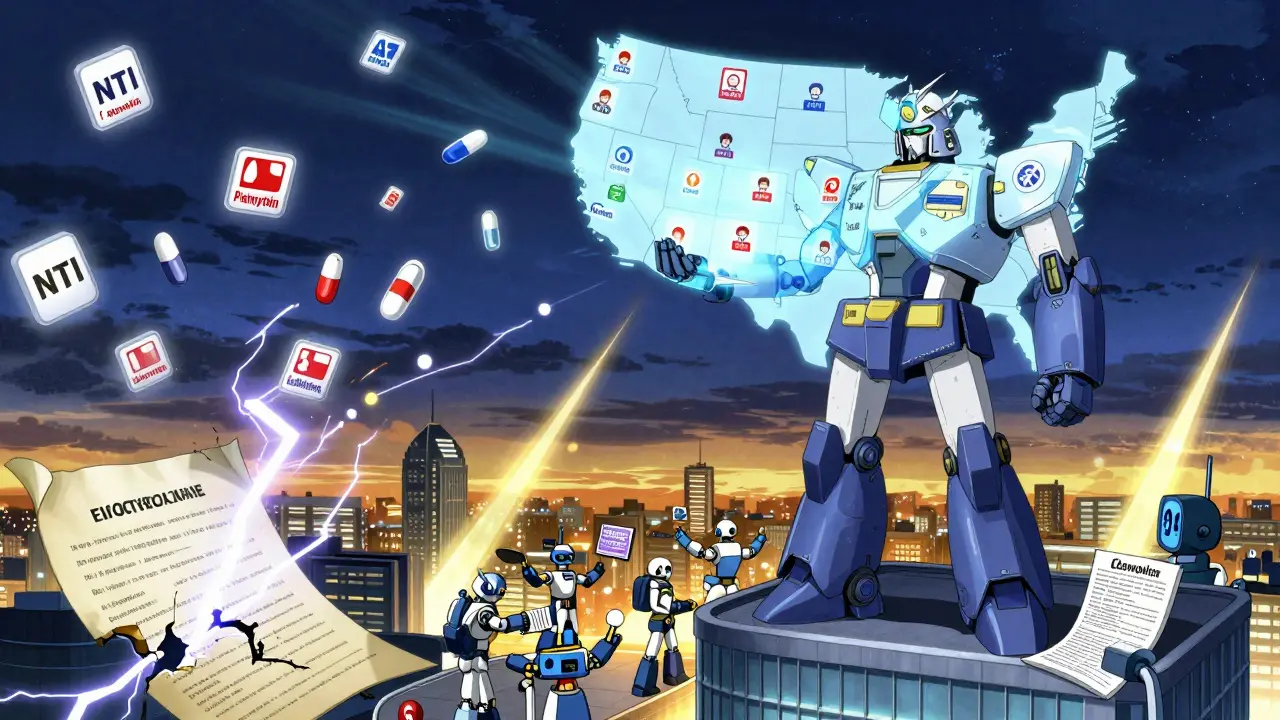
Not all generics are created equal - especially when it comes to NTI drugs. These are medications where even tiny changes in blood levels can cause toxicity or treatment failure. The FDA doesn’t officially label drugs as NTI in the Orange Book, but 17 states have their own lists. In those states, substitution triggers extra steps:
- Pharmacist must document the NTI status
- Prescriber must be notified (sometimes within 24 hours)
- Patient must be counseled and give documented consent
One 2021 case in the Journal of the American Pharmacists Association involved a patient switched from one generic levothyroxine to another without documentation or provider notification. Their TSH levels dropped into the toxic range. They ended up in the ER. The pharmacy had no record of the switch. No one knew what had changed.
That’s why many pharmacists now treat all NTI drugs as high-risk by default - even in states without formal rules. Better safe than sorry.
Electronic systems are the new standard - but they’re not perfect
As of 2023, 98% of chain pharmacies and 87% of independents use electronic systems to log substitutions. That’s a huge shift from paper logs just a decade ago. But the systems aren’t foolproof.
Epic Systems, used by over 1,000 hospitals and pharmacies, found in 2023 that 32% of their clients needed custom configurations to meet state-specific documentation rules. One pharmacy in Illinois had to build a separate workflow for NTI drugs because their EHR didn’t have a built-in field for prescriber notification.
And timing matters. Forty-one states require documentation to be completed within 24 hours of dispensing. If the system goes down, or the pharmacist forgets to click ‘save,’ the record is incomplete - and legally vulnerable.
What happens when documentation fails?
Bad documentation doesn’t just mean a pharmacy gets audited. It means patients get hurt.
A 2022 study across 150 community pharmacies showed that when substitution decisions were fully documented - including manufacturer and lot number - medication errors dropped by 17.3%. That’s not a small number. It’s lives saved.
On the flip side, incomplete records lead to insurance denials. One pharmacist in Ohio reported that his pharmacy lost $12,000 in a single quarter because claims were rejected for missing lot numbers. Insurance companies need that data to verify the drug was dispensed correctly.
Even worse: if a patient has an adverse reaction and the pharmacist can’t prove they documented the switch, they could face disciplinary action from the state board of pharmacy.
What’s changing in 2025?
The landscape is shifting. The FDA’s GDUFA III rules, implemented in 2022, now require manufacturers to submit more detailed bioequivalence data for complex generics - like inhalers or injectables. That means pharmacists may soon need to document not just the manufacturer, but also the specific formulation type.
California’s SB 564 is setting the tone for the future: real-time, prescriber-accessible records. More states are expected to follow. The Centers for Medicare & Medicaid Services (CMS) already require full substitution documentation for Part D drugs, and that’s becoming the de facto standard.
Even more promising: a pilot program using blockchain to track substitutions reduced documentation errors by 22% in a 2023 trial by the National Pharmaceutical Council. Imagine a tamper-proof ledger that logs every substitution, from manufacturer to patient - visible to prescribers, pharmacists, and regulators. That’s not science fiction. It’s coming.
What pharmacists need to do today
Don’t wait for federal rules to catch up. Here’s what you need to do right now:
- Know your state’s laws. Use the National Community Pharmacists Association’s online tool - it’s updated quarterly.
- Set up your EHR to auto-populate substitution fields. Don’t rely on manual entry.
- For NTI drugs, treat every substitution as high-risk - even if your state doesn’t require it.
- Document everything: brand, generic, manufacturer, lot, expiration, patient consent, prescriber notification.
- Train new staff. The average learning curve is 4-6 weeks. Don’t assume they know the rules.
Documentation isn’t busywork. It’s part of your clinical responsibility. You’re not just filling prescriptions. You’re managing risk.
What’s next for generic substitution?
The Department of Health and Human Services’ ASPE is drafting national guidelines for substitution documentation, with a draft expected in early 2024. If adopted, this could finally bring uniformity to a fractured system.
For now, the message is clear: if you’re dispensing a generic, you’re making a clinical decision. And that decision needs to be recorded - clearly, completely, and correctly. Because someone’s health depends on it.


Aditya Kumar
December 15, 2025 AT 16:45Honestly? I skimmed this whole thing. Too much paperwork. If it works, why overcomplicate it?
Also, why do I care who made the generic? As long as it doesn't kill me.
Colleen Bigelow
December 16, 2025 AT 23:08This is just the FDA and Big Pharma’s way to keep you dependent on their overpriced brand-name pills.
They don’t want you to know that the same exact chemical is sold under a different label for 90% less. They’re scared. That’s why they invented ‘NTI’ - to scare patients into paying more.
And now they want real-time EHR logs? That’s surveillance. They’re tracking your meds like you’re a criminal. Next they’ll be scanning your urine for ‘unauthorized generics.’
Remember when they said aspartame was safe? Then glyphosate? Then vaping? They’re lying. Always lying.
Billy Poling
December 17, 2025 AT 03:10It is my professional opinion, grounded in over two decades of clinical pharmacy practice and regulatory compliance experience, that the current state-by-state fragmentation of substitution documentation protocols constitutes a systemic vulnerability in the American pharmaceutical safety infrastructure.
The absence of federal standardization not only impedes interjurisdictional continuity of care but also introduces significant liability exposure for pharmacists who, despite their best intentions, may inadvertently violate the statutory requirements of a jurisdiction to which they are not native.
Furthermore, the reliance upon electronic health record systems that lack interoperability across vendor platforms - such as Epic, Cerner, and Allscripts - creates an environment wherein documentation integrity is contingent upon the idiosyncratic configuration of proprietary software, which is neither auditable nor universally enforceable.
It is therefore imperative that the American Pharmacists Association, in concert with the FDA and CMS, initiate a unified national framework for substitution documentation that mandates the inclusion of manufacturer, lot number, prescriber notification status, and patient consent status as non-negotiable fields, with real-time synchronization across all EHR platforms.
Randolph Rickman
December 17, 2025 AT 23:57This is actually one of the most important things pharmacists do - and no one talks about it.
Documentation isn’t busywork. It’s your shield. When something goes wrong - and it will - you need to prove you did everything right.
And yes, the system’s messy. But you can fix it. Use your EHR’s auto-fill. Set up alerts for NTI drugs. Train your new hires like their license depends on it - because it does.
One patient’s TSH level, one lot number, one consent form - that’s how you stop a disaster before it happens.
Keep doing the work. The system’s broken, but you’re still the one holding the line.
Arun ana
December 18, 2025 AT 17:12This is so true 😊 I work in a small pharmacy in Delhi and we don’t have strict rules here, but I always write down manufacturer and lot just in case.
One lady came back saying her thyroid meds felt 'off' - turned out the new batch had a different filler. We tracked it down because I wrote it down.
Small thing. Big difference. 🙏
Kayleigh Campbell
December 19, 2025 AT 16:56So let me get this straight - we’re spending millions on software so pharmacists can click 7 boxes before giving someone a $4 pill… and the real problem is that the FDA won’t just label the dangerous ones?
Also, ‘NTI’ sounds like a secret society. Are we all in the Matrix now?
Meanwhile, my grandma’s generic metformin still works. Maybe we’re over-engineering this.
Dave Alponvyr
December 20, 2025 AT 14:05Lot numbers matter. Stop ignoring them.
Kim Hines
December 21, 2025 AT 20:08I read this at 3 a.m. while waiting for my shift to start.
It’s weird how something so boring can feel so important.
Just… keep doing the thing. Even when no one’s watching.
Cassandra Collins
December 22, 2025 AT 06:30ok but like… what if the lot number is fake?? like what if the whole system is rigged??
i heard the fda lets chinese factories label generics as ‘made in usa’ and no one checks.
and what if the ehr system gets hacked and they change your meds??
they’re tracking everything now. they know what pills you take. they know when you pick them up.
its all part of the plan. 🤫
Joanna Ebizie
December 23, 2025 AT 16:11You people are overreacting. If you can’t handle documenting a damn lot number, maybe you shouldn’t be handing out meds.
It’s not hard. It’s not ‘oppressive.’ It’s your job.
Stop acting like you’re doing charity work. You’re a professional. Act like one.