
Drinking a glass of grapefruit juice with your morning pills might seem like a healthy habit. But for many people on medication, it could be dangerous - even life-threatening. This isn’t just a myth or a vague warning. It’s a well-documented, scientifically proven interaction that affects more than 85 prescription drugs, with over 40 of them capable of causing serious harm when mixed with grapefruit.
Why Grapefruit Juice Changes How Your Medication Works
Grapefruit juice doesn’t just taste tangy - it changes how your body processes certain drugs. The culprit? Furanocoumarins, natural chemicals found in grapefruit, especially in the pulp and peel. These compounds shut down an enzyme in your gut called CYP3A4, which normally breaks down about half of all oral medications before they enter your bloodstream.
When CYP3A4 is blocked, your body absorbs way more of the drug than it should. That means instead of a safe, controlled dose, you might get two, three, or even five times the intended amount. The effect isn’t temporary. A single 200-milliliter glass (about 6.7 ounces) can inhibit the enzyme for up to 72 hours. That’s why even taking your pill hours after drinking grapefruit juice can still cause problems.
This interaction was first discovered in 1989 by Canadian researchers studying the blood pressure drug felodipine. They noticed that patients who drank grapefruit juice had unexpectedly high drug levels in their blood. Since then, dozens of studies have confirmed the same pattern across many medications. The U.S. Food and Drug Administration (FDA) now requires drug labels to warn about grapefruit interactions if they’re significant.
Medications That Can Become Dangerous With Grapefruit
Not all drugs are affected the same way. Some are barely touched by grapefruit juice. Others? They turn into ticking time bombs.
Statins (cholesterol-lowering drugs) are among the most dangerous. Simvastatin (Zocor) is especially risky. Just one glass of grapefruit juice a day for three days can triple the amount of simvastatin in your blood. That dramatically increases your risk of rhabdomyolysis - a condition where muscle tissue breaks down, releasing toxins that can cause kidney failure. Atorvastatin (Lipitor) has a milder interaction, but it’s still not safe. On the other hand, pravastatin and rosuvastatin don’t interact with grapefruit at all. If you’re on a statin, talk to your doctor about switching to one that’s safe.
Calcium channel blockers for high blood pressure also react badly. Felodipine (Plendil) sees a fivefold increase in blood levels. Nifedipine (Procardia) jumps by 3.3 times. But amlodipine (Norvasc)? It’s mostly unaffected. If you’re on one of these drugs, don’t assume they’re all the same. Your specific medication matters.
Immunosuppressants like cyclosporine (Neoral) - used after organ transplants - can spike by 50-60% with grapefruit juice. That raises the risk of kidney damage and other serious side effects. The same goes for tacrolimus, though it’s less affected than cyclosporine.
Antiarrhythmics like amiodarone (Cordarone) can lead to dangerous heart rhythm changes when grapefruit juice is involved. And even drugs you might not expect, like some anti-anxiety medications or sedatives, can become too strong. But not everything interacts. Trazodone and zolpidem, for example, show little to no interaction. Still, never assume your drug is safe unless you’ve checked.
Not All Citrus Is the Same
Just because grapefruit is dangerous doesn’t mean all citrus fruits are off-limits. Seville oranges - the kind used in traditional marmalade - contain the same furanocoumarins and should be avoided. Pomelos, a close relative of grapefruit, are equally risky.
But sweet oranges (like navel or Valencia), lemons, limes, and tangerines? They’re fine. They don’t contain the compounds that block CYP3A4. So if you’re trying to cut back on grapefruit, you don’t have to give up all citrus. Just stick to the safe ones.

Who’s Most at Risk?
Anyone taking a medication that interacts with grapefruit is at risk. But some groups are more vulnerable.
Older adults are especially at risk. About 40% of people who drink grapefruit juice are 65 or older, and they’re also more likely to be on multiple medications - often three to five at a time. Many of those drugs interact with grapefruit. Their bodies also process drugs more slowly, so even small changes in blood levels can cause big problems.
People with liver or kidney disease are also more sensitive. If your body can’t clear drugs efficiently, extra amounts from grapefruit juice pile up faster.
And here’s the tricky part: you can’t tell who’s more affected just by looking at someone. One person might drink a whole glass and feel nothing. Another might get sick from a sip. It depends on how much CYP3A4 enzyme their gut naturally produces - something doctors can’t test for in routine care.
What Should You Do?
Don’t panic. But do take action.
Step 1: Check your meds. Look at the label. If it says “avoid grapefruit” or “do not consume grapefruit products,” follow it. If you’re not sure, check the prescribing information or ask your pharmacist.
Step 2: Talk to your doctor or pharmacist. Bring your full list of medications - including over-the-counter drugs and supplements. Ask: “Does any of this interact with grapefruit?” Don’t assume they’ll bring it up. A 2022 survey found only 38% of patients recalled being warned about grapefruit interactions when they got their prescription.
Step 3: If your drug is risky, switch or avoid. For statins, switching from simvastatin to pravastatin or rosuvastatin is often an easy fix. For blood pressure meds, amlodipine is a safer alternative to felodipine or nifedipine. For immunosuppressants, tacrolimus may be an option instead of cyclosporine. Your doctor can help you find a safe alternative.
Step 4: Avoid grapefruit entirely during treatment. The FDA says you must avoid grapefruit the whole time you’re on the medication - not just at the time you take your pill. Even if you drink it in the morning and take your pill at night, the enzyme is still blocked. It takes days for your body to make new CYP3A4 enzymes.
Step 5: Watch for symptoms. If you’ve accidentally mixed grapefruit with a risky drug, watch for signs like unexplained muscle pain or weakness (possible rhabdomyolysis), dizziness, irregular heartbeat, nausea, or extreme fatigue. If you notice any of these, contact your doctor right away.
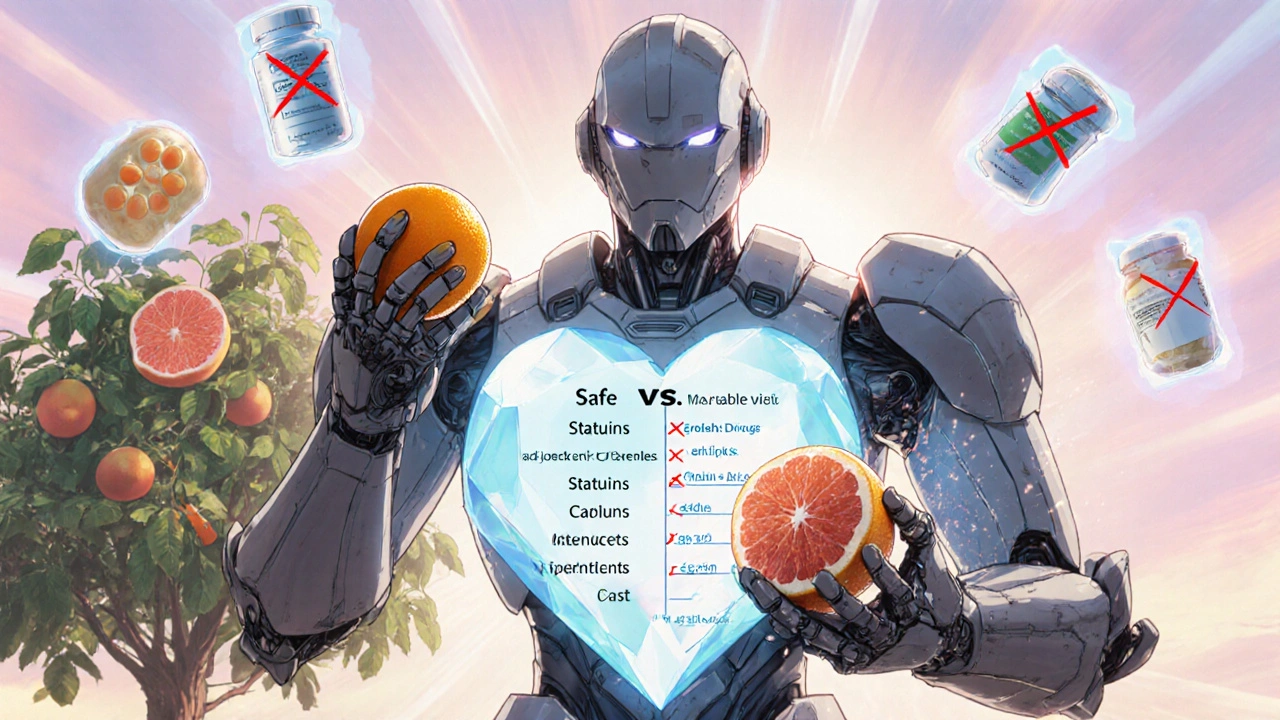
The Bigger Picture
This isn’t just about one fruit. It’s about how food and medicine interact in ways most people don’t realize. Grapefruit juice interactions cost the U.S. healthcare system millions annually due to hospitalizations from side effects. Statin manufacturers lost over $1.2 billion in sales in 2019 alone because patients stopped taking their meds to avoid grapefruit - a sign that the problem is real and widespread.
Researchers are working on solutions. In October 2023, the USDA announced that CRISPR-edited grapefruit with 90% less furanocoumarin had passed early safety trials. In the future, you might be able to enjoy grapefruit without the risk. But that’s still years away.
Until then, the safest choice is simple: if you’re on a medication that interacts with grapefruit, don’t drink it. Period. No exceptions. No "just a little bit." No "I’ve never had a problem before." The risk isn’t worth it.
What About Other Juices or Supplements?
While grapefruit is the most notorious, other substances can interfere with medications too. Pomegranate juice, starfruit, and certain herbal supplements like St. John’s wort can also affect CYP3A4 or other drug-processing pathways. Always ask your pharmacist about any juice, smoothie, or supplement you’re taking - especially if it’s marketed as "natural" or "healthy."
Final Thought
Grapefruit juice isn’t evil. It’s full of vitamin C and antioxidants. But when it meets the wrong medication, it turns into a silent danger. You don’t need to give up your healthy habits - just make sure they don’t clash with your prescriptions. A quick check with your pharmacist could prevent a hospital visit. And that’s worth five minutes of your time.
Can I drink grapefruit juice if I take my medication at night?
No. Grapefruit juice blocks the CYP3A4 enzyme in your gut for up to 72 hours. Even if you drink it in the morning and take your pill at night, the enzyme is still inhibited. The interaction isn’t about timing - it’s about the lasting effect on your body’s ability to process the drug. Avoid grapefruit entirely while on affected medications.
Are all types of grapefruit equally dangerous?
White grapefruit has higher levels of furanocoumarins than red or pink varieties, so it’s more likely to cause interactions. But even red grapefruit can still block CYP3A4 enough to be dangerous. Don’t assume a different color makes it safe. If your medication warns against grapefruit, avoid all types.
Is grapefruit juice the only problem, or does eating the fruit matter too?
Both. The furanocoumarins are in the pulp, peel, and juice. Eating the whole fruit carries the same risk as drinking the juice. Even grapefruit-flavored products like candies, teas, or supplements can contain these compounds. Read labels carefully.
I’ve been drinking grapefruit juice with my meds for years and feel fine. Is it really a problem?
Maybe not right now - but that doesn’t mean it’s safe. The interaction is unpredictable. Some people naturally have more CYP3A4 enzyme and may not notice effects. Others are extremely sensitive. You could be one of the lucky ones today - but that doesn’t protect you from a sudden, dangerous spike in drug levels tomorrow. The risk is real, even if you haven’t had symptoms yet.
What should I do if I accidentally drank grapefruit juice with my medication?
Don’t panic, but monitor yourself. Watch for unusual side effects like muscle pain, weakness, dizziness, irregular heartbeat, nausea, or extreme fatigue. If you notice any of these, contact your doctor or pharmacist immediately. In the future, avoid grapefruit entirely while on that medication. If you’re unsure whether your drug interacts, ask your pharmacist for a list of safe alternatives.



DENIS GOLD
November 30, 2025 AT 02:24Oh wow, another ‘science says don’t do this’ article. Next they’ll tell me not to breathe near my blood pressure meds. 😂 I’ve been drinking grapefruit juice with my statin for 8 years. Still standing. Still walking. Still not in the hospital. Guess I’m just one of those ‘lucky’ ones the article keeps mentioning. Meanwhile, my cousin in India takes his meds with chai and a side of curry - no one’s warning him about turmeric. Double standard much?
Ifeoma Ezeokoli
November 30, 2025 AT 21:11Y’all, this is why I love when people share real science - not fear, not hype, just facts. 🙌 I’m from Nigeria, and here, we drink orange juice with everything, but I had no idea grapefruit could be this sneaky. My auntie takes blood pressure meds and loves her morning grapefruit - I’m sending her this right now. Thank you for making it so clear. Also, the part about ‘not all citrus is the same’? Life-changing. I can still have my lemon water! 🍋💚
Daniel Rod
December 2, 2025 AT 07:42This is one of those posts that makes you pause and think about how little we actually know about our own bodies. 🤔 I used to think ‘natural’ meant ‘safe’ - grapefruit juice, herbal teas, supplements… all just ‘healthy stuff.’ But biology doesn’t care about your intentions. It cares about enzymes, receptors, and chemical pathways. And when you mess with those? It doesn’t ask permission. I’m not scared - I’m just… more careful now. Thanks for the clarity. 🙏
gina rodriguez
December 3, 2025 AT 03:42Just wanted to say thank you for writing this so clearly. I’m a nurse and I see so many patients who don’t know this stuff - even after years on the same meds. The part about ‘don’t assume your drug is safe unless you’ve checked’? That’s the golden rule. I always tell my patients: ‘Your pharmacist is your secret weapon.’ They know the interactions better than anyone. And yes - even the ‘I’ve never had a problem’ crowd. That’s the worst kind of gamble. 💙
Sue Barnes
December 3, 2025 AT 10:19Ugh. Another overblown medical scare tactic. If grapefruit juice was really that dangerous, why isn’t it banned? Why do supermarkets still sell it? Why don’t the FDA just put a skull and crossbones on every bottle? This isn’t science - it’s fear marketing. My mom’s on simvastatin and drinks grapefruit juice daily. She’s 72. Healthy as a horse. You’re scaring people for clicks. Grow up.
jobin joshua
December 4, 2025 AT 01:54Bro, I just took my blood pressure pill with grapefruit juice this morning 😅 I thought it was fine because I read somewhere that red grapefruit is safer. Now I’m sweating. Should I go to ER? I’m from India, we don’t have pharmacists like you guys. Just a guy behind the counter who says ‘take it with water.’ 😭
Sachin Agnihotri
December 5, 2025 AT 12:25Wow, this is actually super helpful - I didn’t realize even the pulp matters! I’ve been eating grapefruit like an apple for years with my meds. I thought juice was the problem. Also, I just checked my statin - it’s simvastatin. Oh no. I’m switching to rosuvastatin tomorrow. My pharmacist said it’s cheaper too. Thanks for the heads-up! 🙏
Diana Askew
December 6, 2025 AT 21:13They don't want you to know the truth. The FDA, Big Pharma, the juice companies - they're all in cahoots. Grapefruit juice is natural. The drugs are synthetic. The real danger is the pharmaceutical industry making you afraid of fruit so you keep buying pills. They don't want you to know that your body can heal itself - they want you dependent. Also, I heard the FDA hides the real data. I'm not taking my meds anymore. I'm doing lemon water and crystals now. ✨