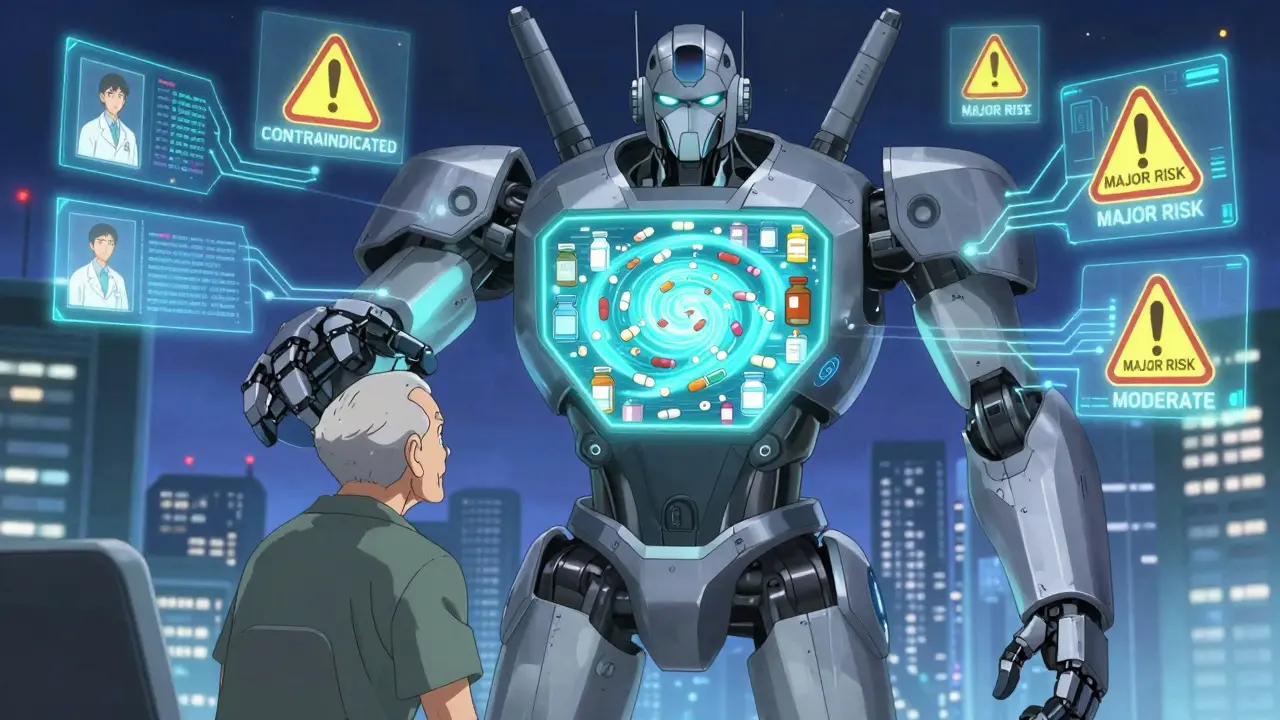
Every year, over 1.3 million people in the U.S. suffer injuries from medication errors. Many of these happen because doctors, pharmacists, or even patients miss dangerous combinations between prescription drugs, over-the-counter pills, and supplements. The good news? You don’t need to guess or flip through thick reference books anymore. Pharmacy apps now give you instant, accurate warnings about drug interactions - right on your phone.
Why Drug Interactions Matter
It’s not just about mixing two pills. A common cold medicine with antihistamines might make your blood pressure medication ineffective. A daily aspirin could turn dangerous when taken with certain blood thinners. Even natural supplements like St. John’s Wort or garlic pills can interfere with prescription drugs. The problem gets worse with age: nearly half of Americans over 65 take five or more medications daily. That’s a lot of chances for something to go wrong.
These aren’t rare edge cases. Studies show that 30-40% of clinically significant interactions go undetected by free or consumer-focused apps. That’s why professionals rely on trusted tools built for clinical use - not just quick searches.
How Pharmacy Apps Work
Modern pharmacy apps don’t just list side effects. They connect the dots between everything you’re taking - prescriptions, OTC meds, vitamins, even herbal teas. When you enter your full list, the app cross-references it against a database of thousands of known interactions. It doesn’t just say “possible interaction.” It tells you:
- Is this a contraindicated mix (never take together)?
- Is it a major risk (could cause organ damage or hospitalization)?
- Is it moderate (may need dose adjustment)?
- Or just minor (unlikely to cause harm)?
Besides checking interactions, many apps also help you identify pills by taking a photo, scan barcodes on bottles, or even using voice input to add medications. Some go further - offering overdose guidance, dosing reminders, and patient education sheets.
Top Pharmacy Apps Compared
Not all apps are created equal. Here’s how the leading options stack up based on real-world use by pharmacists and clinicians:
| App | Max Medications Checked | Offline Access | Free Version? | Key Strength | Limitations |
|---|---|---|---|---|---|
| Epocrates | 30 | Yes | Yes (limited) | Fastest interface, 92% pill ID accuracy | Slower with >20 meds; premium costs $50/month |
| Lexicomp | 50+ | Yes | No | Most comprehensive database, IV compatibility, pharmacogenomics | Steep learning curve; $199/year |
| UpToDate | 50+ | Yes | No | Overdose protocols, toxidrome info, clinical context | Expensive ($499+/year); better for institutions |
| Drugs.com | Unlimited | Yes | Yes | Free, FDA alerts, A-Z drug database | Ads interrupt checks; misses 30-40% of major interactions |
| Medscape | 30 | Yes | Yes | Great disease reference integration | Interaction feature locked behind paywall |
Professional-grade apps like Epocrates and Lexicomp catch 98.7% of serious interactions. Consumer apps like Drugs.com catch about 76%. That gap isn’t small - it’s life-or-death.
How to Use These Apps Effectively
Using the app is simple. Doing it right takes discipline. Follow this workflow:
- Add every medication - not just prescriptions. Include OTC painkillers, sleep aids, vitamins, herbal supplements, and even topical creams. Missing one item can hide a major risk.
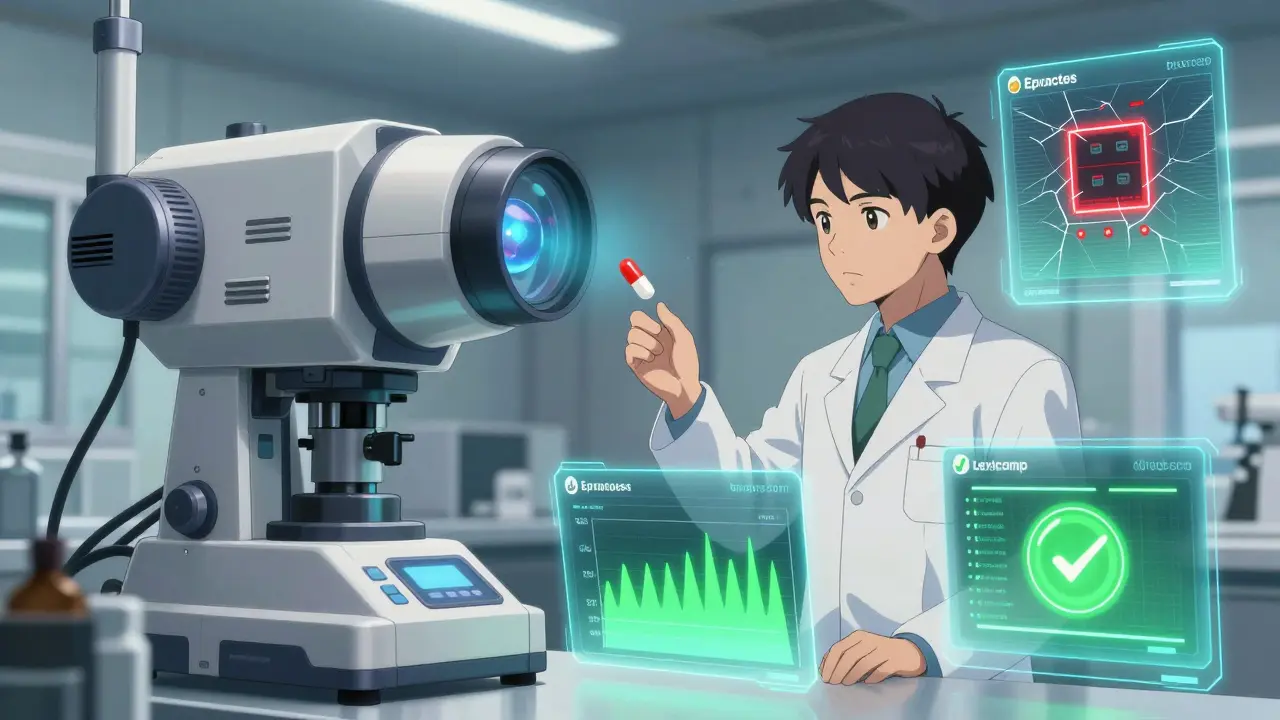
- Use the camera or barcode scanner - if you’re unsure what a pill is, take a picture. Epocrates and others now use AI to match pill shapes, colors, and imprints with over 90% accuracy.
- Review the risk levels - don’t just glance at “moderate” or “minor.” Read the clinical notes. Some interactions only matter if you have kidney disease or are elderly.
- Double-check with a second app - Dr. Robert Johnson’s advice holds true: use Epocrates for speed, and Lexicomp or Micromedex for depth. Cross-referencing catches discrepancies.
- Document your check - write down the date, the app used, and what you found. This protects you legally and helps future providers.
Pro tip: If you’re managing medications for an aging parent, use apps with caregiver sync features. Medisafe lets you add family members who get alerts if a new interaction is flagged.
What to Watch Out For
Even the best tools have blind spots. Here’s what you need to know:
- Free apps aren’t reliable - Studies show free tools miss up to 40% of dangerous interactions. Ads, limited databases, and outdated data make them risky.
- Severity ratings vary - A “major” interaction in one app might be “moderate” in another. A 2023 JAMA study found this happened in 28% of drug pairs. Always read the explanation, not just the label.
- Don’t trust AI predictions alone - New AI features (like Epocrates’ 2023 tool) estimate risk based on comorbidities. They’re helpful, but not replacements for clinical judgment.
- Update regularly - New drug interactions are discovered every week. Apps with automatic updates (like Lexicomp) are safer than ones that require manual downloads.
Who Should Use These Apps?
These aren’t just for doctors. Anyone managing multiple medications should use them:
- Patients on 5+ meds - Especially seniors. Polypharmacy is the #1 cause of preventable hospitalizations in older adults.
- Pharmacists and nurses - A 2023 survey found Epocrates reduced medication errors by 22% in hospitals that adopted it.
- Primary care providers - With CMS requiring interaction checks for Medicare Part D since 2022, this isn’t optional anymore.
- Family caregivers - Apps like Medisafe let you monitor a loved one’s meds remotely and get alerts if something’s wrong.
If you’re a patient, ask your pharmacist to show you how to use one. Most offer free training.
The Future of Drug Interaction Checking
The market is growing fast. The global medication management app industry hit $3.2 billion in 2023 and is projected to hit $8.7 billion by 2028. Why? Because the need is urgent.
New features are rolling out fast:
- AI-powered risk scoring - Apps now factor in age, kidney function, and liver health to predict interaction severity.
- AR pill identification - The latest updates let you point your phone at a pill and see its name, dose, and warnings overlaid in real time.
- Integration with EHRs - Apps like Lexicomp now sync with hospital records, so your doctor sees what you’re taking - even if you didn’t tell them.
But progress isn’t perfect. Discrepancies between databases still exist. That’s why experts agree: never rely on just one app. Use two. Always verify. And never skip checking - even if you’ve taken the same combo for years.
Final Thoughts
Drug interactions don’t care if you’re busy, tired, or confident. They don’t care if you’ve been on a medication for 10 years. A new supplement, a change in dosage, or even a different brand of generic can trigger a silent danger.
Pharmacy apps are the easiest, fastest, and most reliable way to prevent harm. You don’t need to be a doctor to use them. You just need to be careful. Start today - add your medications, check for interactions, and make it part of your routine. It could save your life - or someone else’s.


Sarah Barrett
February 15, 2026 AT 10:40It’s astonishing how something as simple as a pill can carry so much hidden weight. I used to think my multivitamin was harmless-until my pharmacist pulled up a red flag between it and my thyroid med. That moment changed everything.
Now I scan every bottle, even the ones I’ve taken for years. The apps don’t just warn me-they explain why, in plain language. No jargon, no fluff. Just clarity.
It’s like having a clinical mind in your pocket. And yes, I use two apps. One for speed, one for depth. Because when your life’s on the line, you don’t gamble on half-measures.
I’ve started sharing this with my mom. She’s 72, on six meds, and refuses to admit she needs help. So I do it for her. Silent, steady, daily checks. No drama. Just discipline.
It’s not glamorous. But it’s sacred.
Josiah Demara
February 16, 2026 AT 10:35Let’s be brutally honest-most people don’t care until they’re in the ER. This article reads like a PSA for people who already get it. Meanwhile, the guy on Reddit who takes 12 pills and swears ‘I’ve never had a problem’ is still scrolling past this. He’ll die with his phone open to Drugs.com and a bottle of OTC melatonin in one hand.
And yes, Epocrates is $50/month. So? You’re paying for your life. If you can’t afford that, maybe you shouldn’t be on five drugs. The system is broken, not the app.
Stop romanticizing free tools. They’re not ‘accessible’-they’re lethal.
Kaye Alcaraz
February 16, 2026 AT 22:43Thank you for this. Every word matters.
For those feeling overwhelmed-start with one. Just one. Add your most recent prescription. Check it. Then tomorrow, add another. Small steps build safety.
You don’t need to be perfect. You just need to be consistent.
And if you’re helping someone else? That’s not a burden. It’s love in action.
One check today could mean a thousand tomorrows.
You’ve got this.
Charlotte Dacre
February 18, 2026 AT 16:58Oh honey, you’re telling me there’s an app for not dying? I thought we were still in the ‘just Google it and hope’ era.
Turns out, the future is just… careful people with smartphones.
Who knew?
Chiruvella Pardha Krishna
February 20, 2026 AT 11:08The human body is not a machine to be optimized. It is a symphony of unseen forces-each molecule, each receptor, each biochemical whisper. To reduce this sacred complexity to a database of ‘major’ and ‘minor’ risks is not progress-it is hubris.
Perhaps the real interaction is between our arrogance and our mortality. The app does not save us. It merely reflects our fear.
What if the answer lies not in more data… but in stillness?
Virginia Kimball
February 20, 2026 AT 18:06I started using Medisafe after my grandma had a bad reaction to that new blood thinner. Now I’m the one who gets the alerts. It’s wild how something so simple-just typing in a name-can feel like holding someone’s hand.
My mom thinks I’m obsessive. I think she’s just scared. So I keep doing it. Even when she rolls her eyes.
It’s not about being right. It’s about being there.
Kapil Verma
February 22, 2026 AT 14:48Why are Americans so dependent on apps for basic survival? In India, we have 1.4 billion people managing 5+ drugs without a single app. We use memory, tradition, and a pharmacist who knows your name.
This is not innovation. It’s weakness dressed up as technology.
Stop outsourcing your responsibility to a phone. Build relationships. Learn. Observe. Trust your senses.
Or keep paying $199/year to feel safe.
Michael Page
February 23, 2026 AT 05:25I’ve read this three times.
It’s not the data that matters.
It’s the silence between the checks.
The quiet moment before you tap ‘scan’-when you pause and think: ‘What if I’m wrong?’
That’s the real interface.
Not the app.
Us.
Betty Kirby
February 24, 2026 AT 17:16Let me guess-you’re one of those people who thinks ‘free’ means ‘safe.’
Drugs.com catches 76%? That’s like saying your parachute opens 3 out of 4 times. You’re not brave-you’re suicidal.
And don’t get me started on ‘natural supplements.’ St. John’s Wort? That’s not herbal. It’s a chemical grenade with a leaf sticker.
Stop pretending you’re in control. You’re not. The app is your last line of defense. Use it. Or don’t. But don’t pretend ignorance is wisdom.
Erica Banatao Darilag
February 25, 2026 AT 01:28i just wanted to say thank u for writng this. i have been using epocrates for my dad and it has saved us so many times. i mispelled a med once and it still caught the interaction. i cried. really.
its not perfect. but its there. and thats enough.
Esha Pathak
February 26, 2026 AT 16:10Every time I see a person relying on an app to survive, I wonder: are we healing… or just delaying the inevitable?
The body remembers. The soul remembers. The machine forgets.
But perhaps… that’s okay.
Maybe the app isn’t replacing wisdom.
Maybe it’s just holding our hand while we learn to walk again.
🌿
Joe Grushkin
February 27, 2026 AT 03:51Of course the article recommends Epocrates and Lexicomp. They’re expensive. They’re corporate. They’re designed to keep you paying.
Meanwhile, the real innovation is open-source, community-driven databases. The ones you’ve never heard of. The ones built by nurses and pharmacists in their spare time.
But no. Let’s just monetize fear.
How predictable.
Mandeep Singh
February 28, 2026 AT 09:58You think this is about apps? This is about the collapse of the American healthcare system. A 70-year-old woman on 11 medications is not a ‘polypharmacy case’-she’s a symptom. The fact that we’ve normalized this as ‘just part of aging’ is a crime. The app doesn’t fix the problem. It just makes you feel like you’re doing something while the system burns.
And now we’re selling $499/year subscriptions to patch a wound that should never have been made in the first place.
Real change? Ban polypharmacy in seniors. Force prescribers to justify every single drug. Audit every prescription like it’s a firearm.
Until then, your app is just a placebo with a UI.
And don’t you dare call this ‘safety.’ It’s damage control with a subscription model.