
Have you ever looked at a prescription bottle and noticed two different dates? One might be printed on the original box from the factory, while another is handwritten or stamped by your local pharmacist. It’s easy to assume they mean the same thing, but mixing them up can lead to wasted money or, worse, taking a medication that isn’t working as it should.
The difference comes down to who put the drug together and how it was stored before reaching you. One date guarantees the drug's potency from the moment it left the factory. The other tells you how long it stays safe after a pharmacist has mixed, repackaged, or altered it. Understanding this distinction helps you manage your medications better and avoid unnecessary trips back to the pharmacy.
What Is a Manufacturer Expiration Date?
Manufacturer Expiration Date is the specific calendar date until which the pharmaceutical company guarantees the full potency, safety, and quality of an unopened drug product under specified storage conditions. This date is not a guess; it is based on rigorous scientific testing required by regulatory bodies like the U.S. Food and Drug Administration (FDA).
Since 1979, manufacturers have been legally required to perform stability studies on their drugs. They test how the medication holds up against heat, humidity, and light over time. For example, a pill might be tested in a controlled environment at 25°C with 60% humidity for several years. If the drug retains at least 90% of its labeled strength by the end of that period, the manufacturer sets the expiration date accordingly.
This date applies only to the medication in its original, sealed packaging. Once you open the bottle, the clock starts ticking differently because exposure to air and moisture can degrade the pills faster than the lab tests predicted. However, the printed date remains the official limit for the product as manufactured.
What Is a Pharmacy Beyond-Use Date?
Beyond-Use Date (BUD) is the last date a compounded, repackaged, or altered medication can be safely used, determined by the pharmacist based on United States Pharmacopeia (USP) standards. Unlike the manufacturer's date, this is assigned locally by your pharmacy.
You will see a BUD when a pharmacist does something to change the drug's original state. This includes:
- Mixing ingredients to create a custom formulation (compounding).
- Repackaging pills from a large bulk container into a smaller patient-specific bottle.
- Reconstituting a powder with liquid to make a suspension.
- Changing the dosage form, such as turning a tablet into a liquid for a child who can't swallow pills.
Because these processes introduce new variables-like different containers, lack of preservatives, or manual handling-the original manufacturer's guarantee no longer applies. The pharmacist must calculate a new, often shorter, deadline to ensure safety.
How Are These Dates Calculated?
The methods for setting these dates are fundamentally different. Manufacturer expiration dates rely on long-term data collected over years. In contrast, beyond-use dates are calculated using specific guidelines set by the United States Pharmacopeia (USP), specifically Chapters <795> for non-sterile compounding and <797> for sterile compounding.
| Feature | Manufacturer Expiration Date | Pharmacy Beyond-Use Date (BUD) |
|---|---|---|
| Who Sets It? | Pharmaceutical Manufacturer | Compounding Pharmacist |
| Based On | FDA-mandated stability testing | USP guidelines & ingredient stability |
| Typical Duration | 12 to 60 months from manufacturing | 14 days to 1 year (often much shorter) |
| Applies To | Original, unaltered commercial products | Compounded, repackaged, or reconstituted drugs |
| Storage Conditions | Controlled lab environments | Patient home environment (variable) |
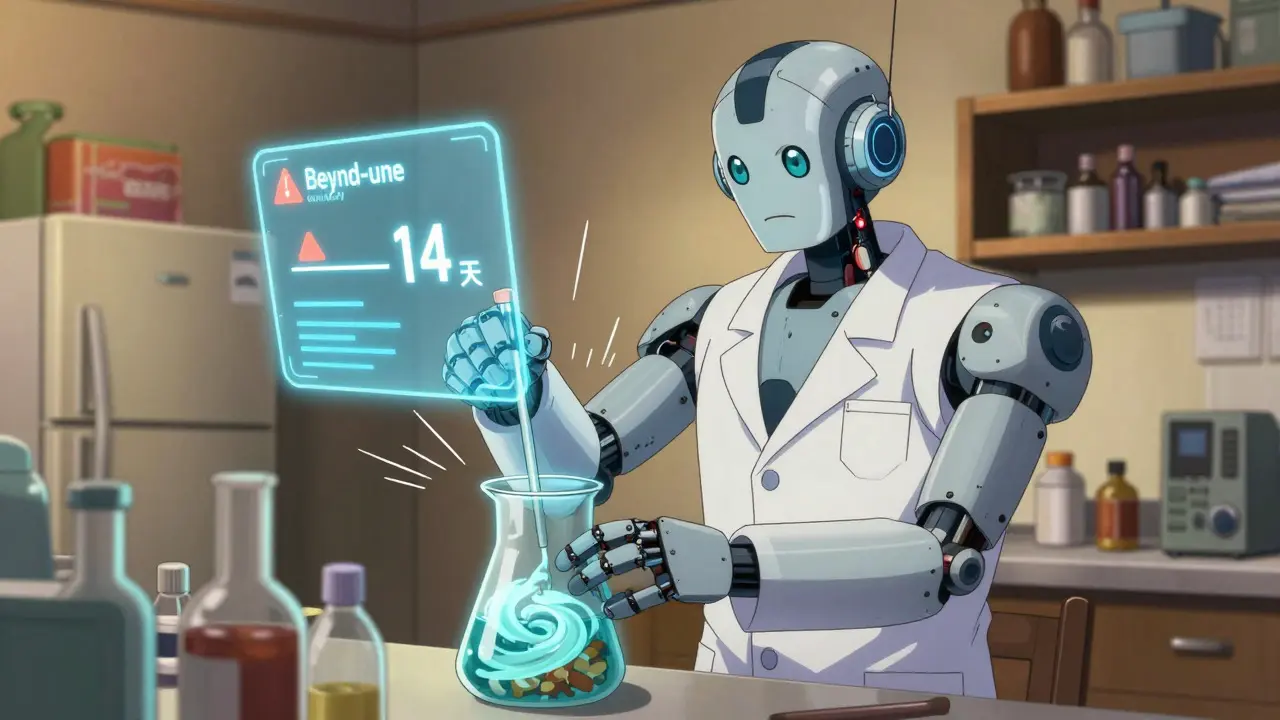
For non-sterile compounded medications, the rules are strict. If a pharmacist mixes a solid dose form, the BUD cannot exceed 180 days at room temperature. If the mixture contains water, it must be refrigerated and used within 14 days to prevent bacterial growth. For repackaged commercial drugs, the BUD is usually the earlier of the original expiration date or one year from the day it was repackaged.
Why Does the Difference Matter?
The gap between these two dates exists because risk changes when you alter a drug. Commercial medications come with preservatives and are sealed in tamper-proof, light-resistant containers designed to protect the chemistry inside. When a pharmacist compounds a medication, they often remove those safeguards.
Consider a patient who needs a thyroid medication without dyes. A standard commercial pill has a dye and a three-year shelf life. A compounded version removes the dye but also lacks certain stabilizers. Without those stabilizers, the active ingredient breaks down faster. If you treated the compounded pill like the commercial one, you might take a dose that is only 50% effective, thinking it was still good.
Additionally, storage plays a huge role. Manufacturers test drugs in perfect conditions. Your bathroom cabinet or kitchen counter experiences temperature swings and humidity changes. Compounded drugs are more sensitive to these shifts. That’s why pharmacists assign conservative BUDs-they account for the imperfect reality of home storage.
Practical Tips for Patients
Navigating these dates doesn’t require a degree in chemistry, just a bit of awareness. Here is how to handle your medications safely:
- Check Both Labels: If you receive a compounded medication, look for the BUD on the vial or bottle. Ignore any old dates on the ingredient boxes unless the pharmacist explicitly says otherwise.
- Follow Storage Instructions Strictly: If the label says "Refrigerate," do not leave it on the counter. Cold temperatures slow down degradation. If it says "Room Temperature," keep it away from direct sunlight and heat sources like stoves.
- Don’t Hoard Compounded Meds: Because BUDs are short, try to order only what you need for a month or two. A 2022 survey found that 68% of patients throw away compounded meds because they expire before finishing the course. Ordering smaller quantities reduces waste.
- Ask Questions: If a BUD seems surprisingly short, ask your pharmacist why. They can explain if it’s due to the presence of water, lack of preservatives, or instability of the specific ingredient.
- Dispose Properly: Never flush medications unless instructed. Most pharmacies offer take-back programs. Using a drug past its BUD or expiration date risks reduced efficacy or contamination.
Common Scenarios Explained
Let’s look at a few real-world examples to clarify how these dates work in practice.
Scenario 1: The Repackaged Antibiotic
You buy a common antibiotic. The pharmacy takes pills from a large stock bottle and puts ten into a small amber bottle for you. The stock bottle expires in 2028. However, the pharmacy stamps a BUD of six months from today. Why? Because once the stock bottle is opened, moisture enters. The USP guideline for repackaged solids allows up to one year, but many pharmacies use a six-month window to be extra safe. You must follow the six-month BUD, not the 2028 date.
Scenario 2: The Custom Liquid Suspension
Your child needs a pain reliever that comes only in adult tablets. The pharmacist crushes the tablets and mixes them with a flavored syrup. This new mixture has no preservatives. Even though the original tablets were good for two years, the new liquid suspension gets a BUD of 14 days if kept in the fridge. After two weeks, bacteria could grow, or the drug could lose potency. Throw it out and get a fresh batch.
Scenario 3: The Unopened Prescription
You have an unopened bottle of blood pressure medication sitting in your cabinet. It was dispensed in 2023, but you never started taking it. The label says "Expires: March 2026." Since the bottle was never opened and stored properly, you can generally trust this manufacturer expiration date. However, always check with your pharmacist first, especially if the storage conditions were less than ideal (e.g., a hot car trunk).
Regulatory and Safety Context
The rules governing these dates are enforced by different entities. The FDA oversees manufacturer expiration dates through federal law (21 CFR 211.137). State boards of pharmacy and the USP oversee beyond-use dates. This split means consistency can vary slightly depending on where you live, but the core principle remains: alteration equals shorter shelf life.
In recent years, the market for compounding pharmacies has grown significantly, reaching $11.7 billion annually in the U.S. With more people needing customized meds, regulators have tightened scrutiny. In 2022 alone, the FDA issued dozens of warning letters to pharmacies for improper BUD assignment. This shows that getting the date right is a serious safety issue, not just paperwork.
Experts like Dr. Daniel Sheridan, RPh, MS, emphasize that the expiration date is valid only under the specific conditions tested by the manufacturer. Once you change the formulation-even slightly-that guarantee voids. The BUD steps in to fill that gap, providing a scientifically backed timeframe for the new, altered product.
Can I use a medication past its manufacturer expiration date?
Officially, no. The FDA recommends discarding drugs after their expiration date because potency and safety are no longer guaranteed. While some studies show many drugs remain stable for years past this date under ideal conditions, real-world storage varies too much to rely on this. Always consult your pharmacist before using expired medication.
Why is my compounded medication's BUD so short?
Compounded medications often lack the preservatives and protective packaging of commercial drugs. Factors like the presence of water, the type of ingredients, and the method of preparation determine the BUD. Water-based mixtures, for instance, are prone to bacterial growth and often have a BUD of just 14 days when refrigerated.
Does opening a bottle change the expiration date?
Yes, indirectly. The manufacturer's expiration date applies to the unopened product. Once opened, exposure to air and moisture can degrade the drug faster. For most oral solids, pharmacists recommend using them within 6 months to 1 year of opening, even if the printed date is later. Liquids and eye drops often have shorter post-opening lifespans.
What happens if I take a medication past its BUD?
Taking a medication past its Beyond-Use Date poses risks of reduced efficacy, meaning it may not treat your condition effectively. In some cases, especially with liquids or ointments, there is a risk of microbial contamination, which could cause infection. It is best to discard the medication and obtain a fresh supply.
How should I store compounded medications?
Always follow the specific instructions on the label. Some compounded meds require refrigeration to maintain stability, while others must be kept at room temperature to prevent freezing or crystallization. Keep them away from direct sunlight, heat, and humidity. If in doubt, ask your pharmacist for precise storage guidance.