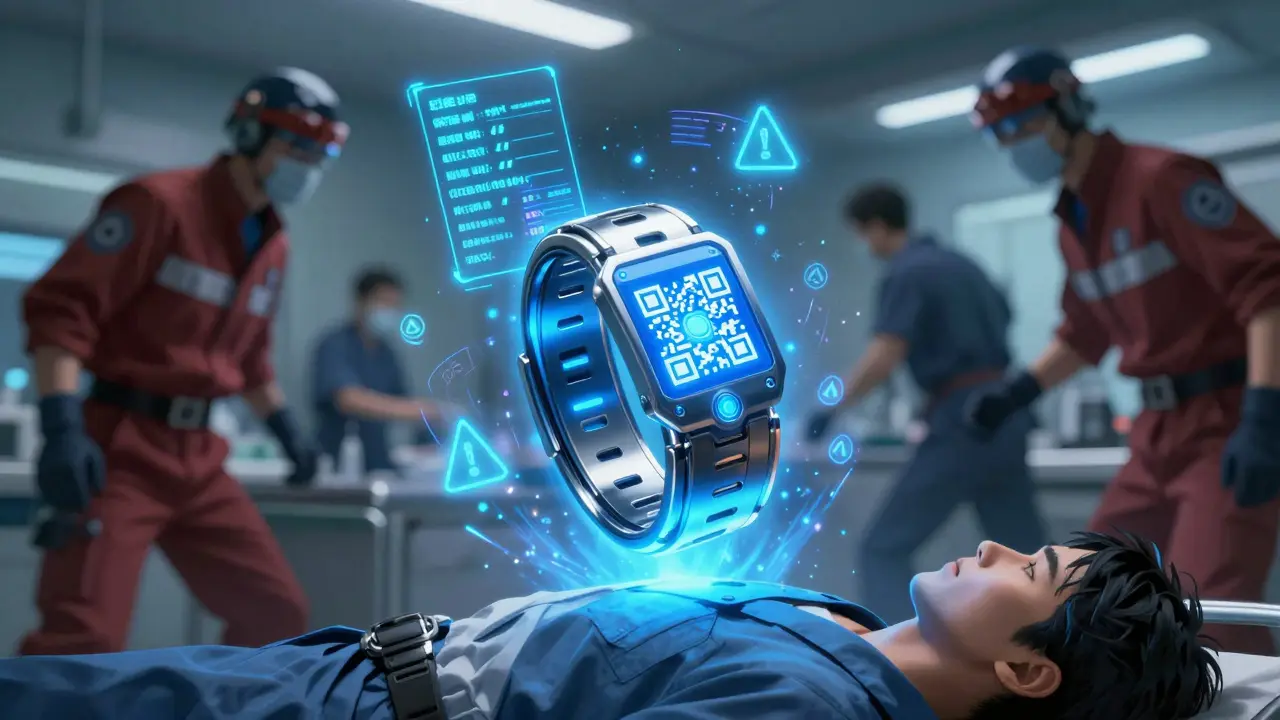
Medical Alert Information Checklist
Your Drug Safety Checklist
Enter your medical information to get personalized recommendations for your medical alert bracelet.
When you’re rushed to the ER after a fall, heart attack, or seizure, you won’t be able to tell doctors what medications you’re on. That’s where a simple metal band on your wrist can save your life. Medical alert bracelets aren’t just accessories-they’re emergency lifelines, especially when it comes to drug safety. In the first few minutes of a medical crisis, every second counts. A bracelet with clear, accurate information can prevent deadly mistakes that regular hospital charts might not catch in time.
Why Medication Errors Happen in Emergencies
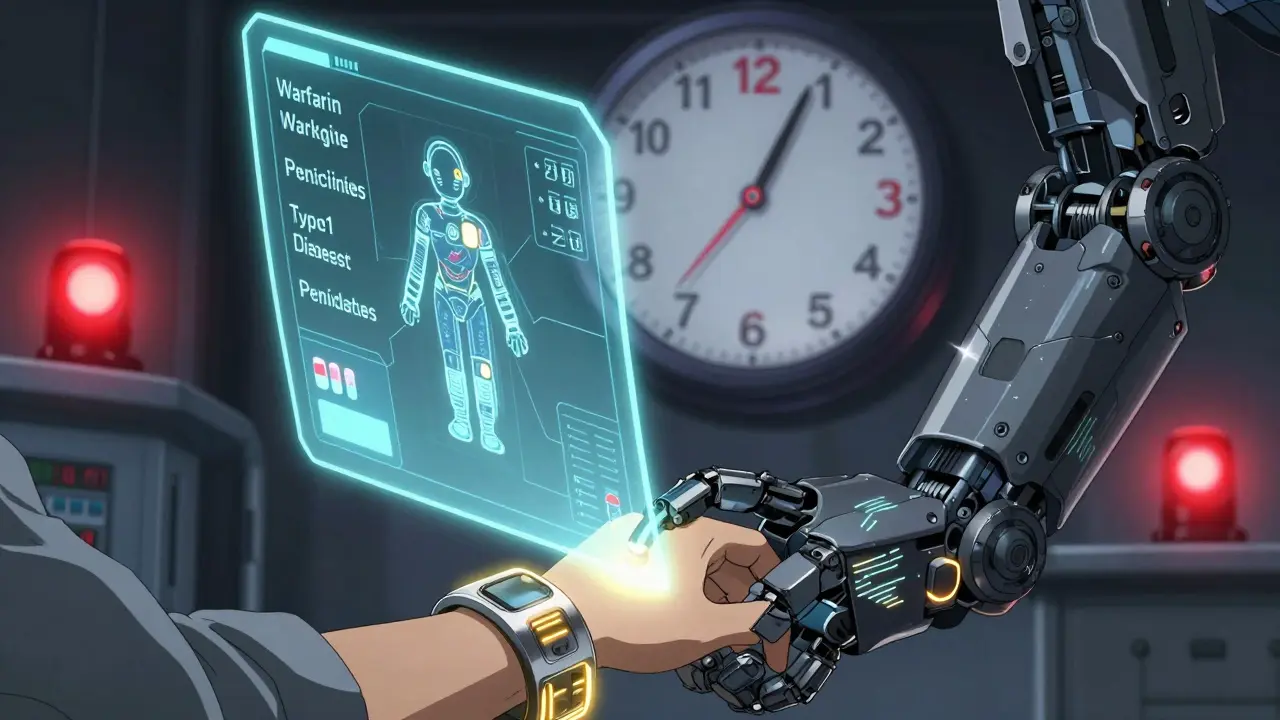
Emergency rooms are chaotic. Staff are juggling multiple patients, missing records, and sometimes even wrong patient IDs. A 2022 study in the Journal of Emergency Medicine found that 37% of ER errors involve medications. That’s not rare-it’s common. And many of those errors happen because doctors don’t know what drugs you’re taking. You might be on warfarin, a blood thinner that can turn a minor cut into a life-threatening bleed. Or maybe you’re allergic to penicillin, and the nurse reaches for it without knowing. Without your medical history, they guess. And guessing with drugs can kill.
First responders are trained to look at wrists and necks the moment they arrive. The American College of Emergency Physicians says this is standard procedure. But if the bracelet says only “ALLERGIES” or “ON BLOOD THINNERS,” that’s not enough. You need specifics. Which drug? What dose? What’s the risk?
What Information Actually Saves Lives
Not all medical ID bracelets are created equal. The most effective ones follow a clear priority list, backed by emergency medicine guidelines:
- Drug allergies - Especially penicillin (affects 10% of Americans), latex, sulfa drugs, and NSAIDs like aspirin or ibuprofen. Anaphylaxis can strike in under five minutes.
- Current critical medications - Blood thinners like warfarin (used by 2.9 million Americans), insulin for diabetics, and seizure meds like phenytoin. These change how doctors treat you. Giving insulin to a Type 2 diabetic who’s not dependent on it? Dangerous. Giving glucose to a Type 1 diabetic who’s overdosed? Deadly.
- Chronic conditions - Diabetes, heart disease, epilepsy, kidney failure. Each requires specific emergency protocols.
Traditional engraved bracelets have space for about 3-5 key items. That’s why people often leave out details. One user told Consumer Reports their bracelet only said “ON BLOOD THINNERS”-but didn’t say which one. The ER team still had to run tests to figure it out, wasting precious minutes.
QR Code Bracelets: The New Standard
Since 2018, digital medical IDs have changed the game. QR code bracelets-like those from MedicAlert Foundation-link to a secure online profile. Tap the code with a smartphone, and emergency staff see your full medication list, dosages, allergies, doctors’ contact info, and even your pharmacy. No space limits. No guesswork.
Over 4 million people globally use these services. In 2023, the MedicAlert Foundation reported that 68% of their users listed medication information, with 42% specifically citing blood thinners. These aren’t just convenience features-they’re safety upgrades. A 2023 study by MobileHelp documented 142 cases where QR bracelets prevented fatal drug interactions, especially with anticoagulants.
And it’s getting smarter. In January 2024, MedicAlert launched SmartProfile, which syncs with pharmacy databases to auto-update your profile when your prescriptions change. No more forgetting to update your bracelet after a doctor adds a new drug.
Real Stories: When the Bracelet Made the Difference
Reddit user ‘AllergicAmy’ shared her story: during an appendectomy, doctors were about to give her penicillin. Her bracelet clearly said “ANAPHYLACTIC TO PENICILLIN.” The nurse stopped, checked, and switched antibiotics. She later learned she’d have died within minutes if they’d gone ahead.
On Trustpilot, 63% of MedicAlert customers say they bought the bracelet for drug safety reasons. One man with atrial fibrillation said his bracelet stopped a hospital from giving him a clot-busting drug that would’ve caused internal bleeding-he was on Eliquis, and they didn’t know. Another woman with Type 1 diabetes had her insulin dose adjusted because her bracelet listed her insulin type and pump settings, avoiding a dangerous low-blood-sugar reaction.
But it’s not perfect. A Johns Hopkins audit of 500 emergency cases found that 19% of bracelets had outdated or incomplete info. That’s why keeping your profile current matters more than owning the bracelet.
What to Put on Your Bracelet (And What to Skip)
Here’s what works, based on ACEP guidelines and real-world ER feedback:
- DO include: Full drug names (warfarin, not just “blood thinner”), exact allergies (penicillin, not “antibiotic allergy”), diabetes type (Type 1 vs. Type 2), insulin dependence, and EMT contact info.
- DO use: NDC codes (National Drug Codes) if your provider supports them. They’re unique identifiers that help ER staff find the exact drug, even if brand names differ.
- DO NOT include: Your Social Security number, home address, or vague terms like “allergies” or “chronic condition.”
Too much info? Use a QR bracelet. It holds your entire medication list, recent lab results, and even your advance directive. No clutter. Just instant access.
Cost, Maintenance, and Choosing the Right One
Basic engraved metal bracelets start at $49.99. QR code versions start at $69.99, with a $59.99 annual fee for profile updates. That’s less than $5 a month for peace of mind. Medical Guardian’s 2025 system-combining a bracelet with 24/7 emergency monitoring-starts at $29.95 monthly.
But cost isn’t the biggest issue. The biggest risk? Outdated info. The American Pharmacists Association says 35% of users never update their bracelets after a medication change. That’s dangerous. A drug you stopped six months ago might still be listed. A new allergy? Not on there. That’s why automatic syncing with your pharmacy’s system is the future-and why services like SmartProfile are game-changers.
Customer service matters too. MedicAlert Foundation scored 4.3/5 in J.D. Power’s 2024 study. Smaller providers? Only 3.1/5. If you’re going to rely on this, choose a provider with real support.

Who Needs One Most?
You don’t have to be elderly or frail to need this. The National Health Interview Survey (2024) shows:
- 41% of warfarin users wear one
- 33% of severe allergy sufferers
- 28% of diabetics
But here’s the truth: if you take three or more medications daily, have a known allergy, or manage a chronic condition like heart disease, epilepsy, or kidney failure-you’re at risk. And risk doesn’t care if you’re 25 or 75.
The Bigger Picture: Hospitals Are Starting to Require Them
The 2022 CARES Act requires all U.S. hospital ERs to check for medical IDs. 67% of hospitals now include medical ID verification in their standard intake process. The FDA’s 2023 Medical ID Modernization Initiative is pushing for standardized formatting so first responders everywhere recognize the same symbols and codes.
Future systems will connect directly to hospital records. Epic Systems and Cerner are building APIs that auto-update your bracelet profile when your doctor changes your meds. Imagine: you get a new prescription. Your pharmacy sends the update. Your bracelet reflects it the next day. No manual entry. No forgotten updates.
Johns Hopkins’ 2024 modeling predicts this integration could reduce medication-related ER complications by 35%. That’s not a small win. That’s thousands of lives saved every year.
Final Thought: It’s Not Just a Bracelet. It’s Your Voice.
When you can’t speak, your bracelet speaks for you. It’s not about looking “medical.” It’s about staying alive. A simple piece of jewelry, engraved with truth, can stop a lethal mistake before it starts. In emergencies, information is power. And with the right bracelet, you hold that power-even when you’re unconscious.
Do medical alert bracelets really work in emergencies?
Yes. First responders are trained to check wrists and necks for medical IDs. A 2023 study by MobileHelp documented 142 cases where these bracelets prevented fatal drug interactions. The American College of Emergency Physicians confirms that medical IDs reduce medication errors by 28% in unconscious patients. When the information is accurate and specific, they save lives.
What’s the most important thing to put on a medical alert bracelet?
Drug allergies and critical medications come first. Specifically, list the exact drug names: "ALLERGIC TO PENICILLIN" not just "ALLERGIES," and "ON WARFARIN 5MG DAILY" instead of "BLOOD THINNER." These details tell emergency teams how to treat you safely. If you have diabetes, specify Type 1 or Type 2 and whether you use insulin.
Are QR code bracelets better than engraved ones?
For drug safety, yes. Engraved bracelets are limited to 3-5 items due to space. QR code bracelets link to a full digital profile with your entire medication list, dosages, allergies, doctors, and emergency contacts. Services like MedicAlert’s SmartProfile even auto-update when your prescriptions change, solving the biggest problem: outdated info.
What if I forget to update my bracelet after changing medications?
That’s a real risk. 35% of users never update their bracelets after a medication change. To avoid this, use digital services that sync with pharmacy databases. MedicAlert’s SmartProfile and similar systems automatically update when your doctor changes your prescription. Set calendar reminders too-every time your meds change, update your profile within 24 hours.
Do I need to wear it all the time?
Yes. The National Council on Aging found that 73% of emergencies involving medical IDs happen when the person is away from home-on vacation, at work, or out shopping. If you don’t wear it, it doesn’t help. Make it part of your daily routine, like brushing your teeth.

Kevin Y.
March 24, 2026 AT 11:17Thank you for this incredibly well-researched piece. As someone who works in hospital administration, I’ve seen firsthand how a simple medical ID can prevent catastrophic errors. One time, a patient came in unconscious after a car crash-no wallet, no phone, no ID. But his bracelet listed he was on warfarin and allergic to sulfa. That saved his life. We’re pushing to make these mandatory in our intake流程 now.
Raphael Schwartz
March 26, 2026 AT 04:47bruh why even bother. hospitals are a mess anyway. theyll just give you the wrong drug anyway. i seen a guy get morphine when he was allergic. bracelet? lol. they dont even read em.
Aaron Sims
March 28, 2026 AT 02:38Ohhh, so now we’re trusting QR codes to save our lives? Next thing you know, they’ll be scanning your iris to decide if you’re ‘worthy’ of epinephrine. This is just another step toward the medical surveillance state. Who owns the database? Who controls the updates? And why is there a $60/year fee for my right not to die? #BigPharmaGreed
Caroline Bonner
March 28, 2026 AT 17:58I just got my QR bracelet last week after my sister nearly died from a drug interaction-she was on lithium and got an antibiotic that shouldn’t have been mixed, and the ER team had no idea because she didn’t have anything on her. I cried for an hour after hearing the story. This isn’t just about convenience-it’s about dignity. When you’re unconscious, you can’t scream ‘I’m allergic!’-but your bracelet can. Please, if you take more than three meds, get one. And update it. I set a recurring calendar reminder every time I refill anything. It’s a 30-second habit that could save you-or someone you love.
Seth Eugenne
March 28, 2026 AT 21:24Love this. Seriously. I wear mine every day-even to bed. Got it after my dad had a stroke and they almost gave him aspirin (he was on Eliquis). He’s fine now, but I still get chills thinking about it. 🙏
Alex Arcilla
March 29, 2026 AT 03:38bro i got a qr bracelet and its so sick. like i got my whole med list, my doc’s number, my blood type, even my advance directive. last month i passed out at the gym and the paramedics scanned it and knew exactly what to do. no guesswork. just pure clarity. yall need to get one. its not a fashion statement, its a survival tool.
Stephen Alabi
March 31, 2026 AT 03:36While the sentiment is admirable, the data presented lacks statistical rigor. The MobileHelp study cited has a self-reported sample size of 142 cases-none of which were peer-reviewed or independently verified. Furthermore, the 28% reduction in medication errors attributed to medical IDs is drawn from a non-representative cohort. The true efficacy remains unproven. One must be cautious not to conflate anecdotal success with population-level impact.
Agbogla Bischof
April 1, 2026 AT 14:55As a pharmacist from Lagos, I can confirm: this is critical. In Nigeria, many patients don’t have records. A bracelet is their only voice. I’ve seen patients die because no one knew they were on digoxin. I now hand out free engraved bracelets to elderly patients with hypertension. Simple. Cheap. Life-saving. QR is great, but not everyone has a smartphone. The engraved version still saves lives daily.
Pat Fur
April 3, 2026 AT 01:26It’s not about the bracelet. It’s about who gets to decide what ‘critical’ info is. Who decides if your insulin pump settings matter more than your depression meds? The system decides. And that’s the real danger.
peter vencken
April 3, 2026 AT 17:07just got mine last week. i was skeptical but now i wear it like a badge. my doc said if i ever pass out, they’ll know i’m on topiramate and lithium. no more ‘is this a seizure or just a bad trip?’ moments. also, the app auto-updates when my pharmacy sends refills. mind blown.
Chris Crosson
April 5, 2026 AT 00:27Anyone else think it’s wild that we need to wear our medical history like a necklace? Why isn’t this data synced across all hospitals? Why do I have to beg my doctor to update it? This shouldn’t be on me. It should be in the system.
Linda Foster
April 5, 2026 AT 01:39The evidence supporting medical alert bracelets is compelling, and the integration with pharmacy databases represents a significant advancement in patient safety. However, one must consider the ethical implications of data portability and patient autonomy. Ensuring informed consent in digital medical profiles remains a critical consideration.
Rama Rish
April 7, 2026 AT 00:18My mom has diabetes and she wears one. I told her to add her insulin type. She said ‘it’s just sugar’. I cried. Now she updates it every time she changes meds. We need to talk more about this.