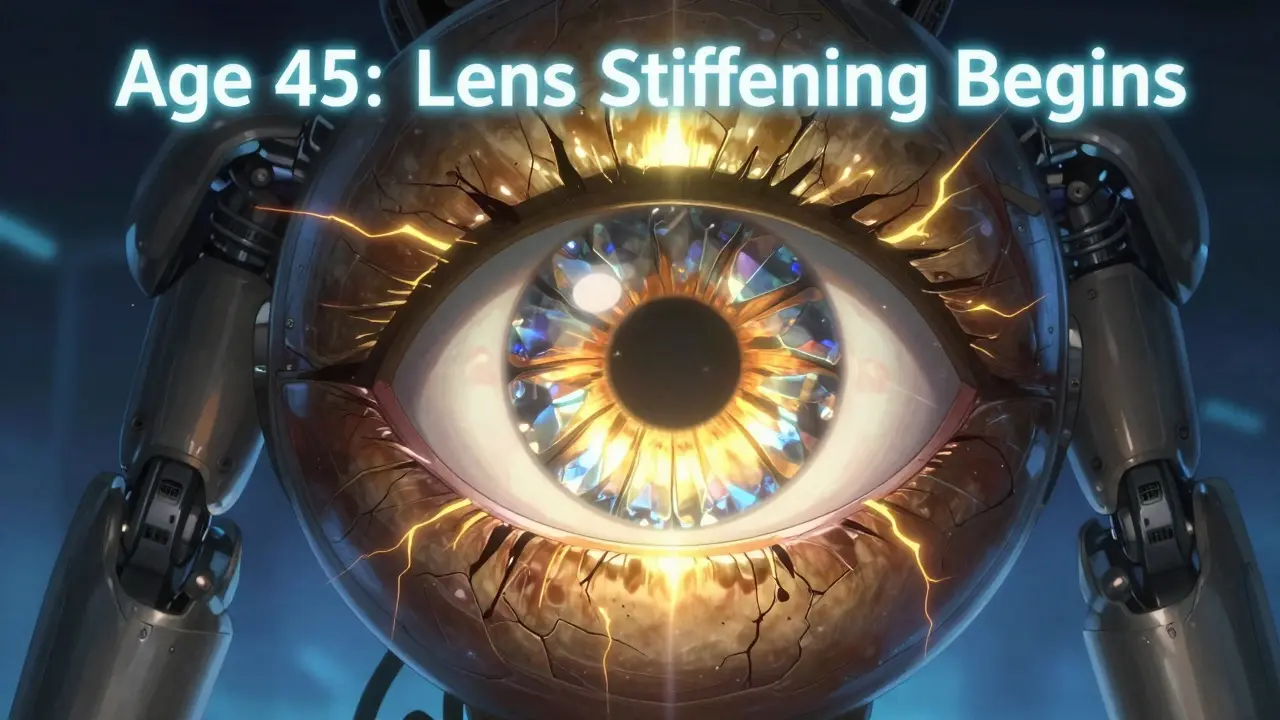
By the time you hit your mid-40s, you might start holding your phone farther away to read the text. Or maybe your menu at dinner looks blurry unless you squint. This isn’t just bad lighting or tired eyes-it’s presbyopia, a normal part of aging that affects nearly everyone. Unlike nearsightedness or farsightedness, presbyopia isn’t about the shape of your eyeball. It’s about your lens. As you get older, the natural lens inside your eye slowly hardens and loses its flexibility. That’s why it can’t bend light properly anymore to focus on close-up things like books, phones, or recipes.
Why Your Eyes Stop Focusing Up Close
Your eye’s lens works like a tiny, flexible magnifying glass. When you’re young, it easily changes shape to bring near objects into focus. At age 10, your eyes can focus on something as close as 7 centimeters. By age 60, that distance stretches to over 100 centimeters. That’s why you end up holding your coffee cup at arm’s length just to read the label.
This isn’t a disease. It’s biology. The lens keeps adding layers of cells over time-like an onion growing ring by ring. Those extra layers make it stiffer. The muscles around it also weaken slightly. Together, they reduce your eye’s ability to accommodate, or adjust focus. By age 45, most people need about +1.00 diopter of correction. By 65, that jumps to +2.50 to +3.00. The National Eye Institute confirms this is universal: every human who lives long enough will develop presbyopia.
Reading Glasses: The Simple Fix
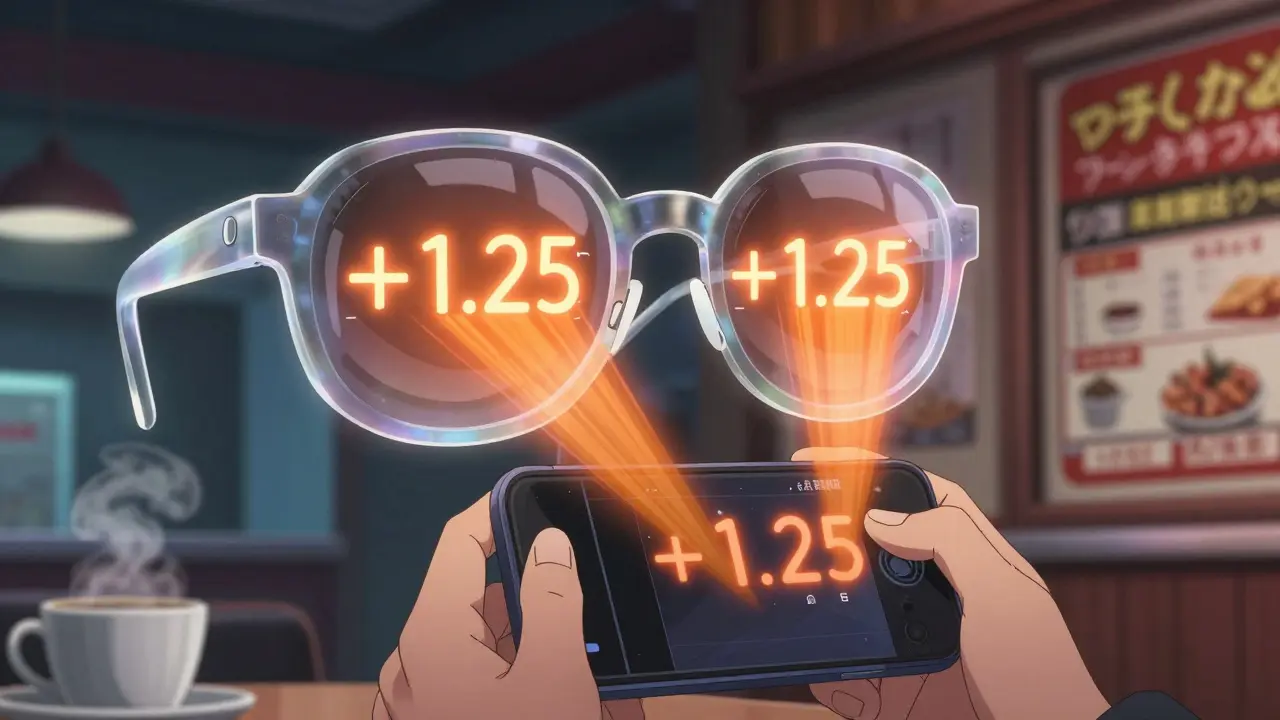
For many, reading glasses are the easiest answer. They’re cheap, widely available, and work instantly. You can buy them at any pharmacy, grocery store, or online for under $20. Brands like Zenni, Warby Parker, and even Walmart sell them in strengths from +0.75 to +3.50 diopters, in 0.25 increments. Most people start with +1.00 or +1.25 and increase as needed.
But here’s the catch: over-the-counter readers aren’t custom. They assume both eyes need the same correction, and they don’t account for your exact pupil distance or astigmatism. About 35% of people end up with the wrong strength, which can cause headaches, eye strain, or blurred vision. If you’re using them daily for computer work or detailed tasks, a proper eye exam is worth it. A comprehensive exam includes cycloplegic refraction-a test that temporarily relaxes your eye muscles to measure your true focusing needs. Without it, your prescription could be off by half a diopter or more.
Progressive Lenses: The Seamless Alternative
If you already wear glasses for distance vision, reading glasses become a hassle. You’re constantly switching between pairs. That’s where progressive lenses come in. These are single lenses with three zones: distance at the top, intermediate in the middle (for computer screens), and near at the bottom. No visible lines like in bifocals.
They’re more expensive-$250 to $450 depending on the brand and material-but they let you see clearly at all distances without changing glasses. The trade-off? Adaptation. About 25% of first-time wearers report peripheral distortion, especially when walking down stairs or turning your head quickly. It usually takes 2 to 4 weeks to adjust. Some people never fully adapt. Newer designs, like Essilor’s Eyezen Progressive 2.0, have wider near zones and improved optics based on data from 10,000 wearers. Still, even the best progressives don’t give you perfect vision everywhere. Dr. George Witkin of NYU Langone says only 60% of users achieve truly sharp near vision without compromise.

Other Options: Contacts, Surgery, and What’s Coming
Some people try monovision contact lenses-one eye corrected for distance, the other for near. It works for about 80% of users, but 15% lose depth perception, making driving or sports harder. LASIK monovision costs $2,000 to $4,000 per eye and has an 85% satisfaction rate, but 10-15% need a second procedure within five years.
Surgery options like refractive lens exchange replace your natural lens with a multifocal intraocular lens. It’s similar to cataract surgery and costs $3,500 to $5,000 per eye. The upside? Permanent correction. The downside? Risks like halos at night (25% of patients), reduced contrast sensitivity, and a tiny chance of infection (0.04%).
New tech is emerging. In 2023, Johnson & Johnson got FDA approval for Acuvue Oasys Multifocal with better near vision performance. Presbia’s Flexivue Microlens-a tiny implant placed in the cornea-showed 78% of users achieving 20/25 near vision after a year. Researchers are also testing eye drops like VP-025, which temporarily improve focusing ability for up to six hours. These aren’t cures, but they could change how we manage presbyopia in the future.
When to See an Eye Doctor
The American Academy of Ophthalmology recommends a full eye exam at age 40, even if you think your vision is fine. Presbyopia often shows up around then, but other conditions like glaucoma or macular degeneration can sneak in too. An exam doesn’t just check your reading power-it looks at your overall eye health. If you’re noticing sudden changes in vision, double images, or eye pain, don’t wait. These aren’t signs of presbyopia.
For most, the solution is simple: get the right glasses. Whether it’s a $10 pair for occasional use or custom progressives for daily life, the goal is the same: keep reading, cooking, texting, and working without strain. Your eyes aren’t broken. They’re just aging-and that’s okay.
Is presbyopia the same as farsightedness?
No. Farsightedness (hyperopia) is caused by an eyeball that’s too short or a cornea that’s too flat, making it hard to focus on close objects even when young. Presbyopia is caused by the lens losing flexibility with age. You can have both at the same time, but they’re different conditions.
Can eye exercises or diet prevent presbyopia?
No. Dr. Emily Chew from the National Eye Institute says presbyopia is as inevitable as gray hair. No amount of eye yoga, supplements, or vitamins can stop the lens from hardening over time. It’s a mechanical aging process, not a lifestyle issue.
How often do I need stronger reading glasses?
Most people need to upgrade their reading glasses every 2 to 3 years between ages 45 and 65. After 65, the change slows down. Your prescription may increase by 0.25 to 0.50 diopters each time. Don’t wait until you’re squinting-get checked if you notice new strain or headaches during reading.
Are cheap reading glasses safe to use?
They’re safe for occasional use, like reading a label or a recipe. But if you use them for hours a day-especially on screens-they can cause eye fatigue, headaches, or neck pain. Poor lens quality can also distort vision. For daily use, custom lenses with proper measurements are better.
Do progressive lenses work for computer use?
Yes, but not all progressives are made equal. Standard progressives are designed for reading and distance, not mid-range computer screens. Occupational progressives, with a wider intermediate zone and 14-16mm corridor length, are better for desk work. Many graphic designers and office workers switch to these specifically to reduce screen strain.
At what age does presbyopia usually start?
Most people notice symptoms between 40 and 45. Some see it earlier if they’re farsighted or work long hours on screens. Others may not notice until their late 40s. It’s not sudden-it creeps in slowly. The first sign is often needing more light to read or holding printed material farther away.
Can I still wear contact lenses with presbyopia?
Yes. Multifocal contacts like Acuvue Oasys Multifocal or Biofinity Multifocal are designed for presbyopia. They work well for many, but not everyone adapts. Success rates are around 80%, but you might need to try a few brands before finding one that clicks. Some people combine them with reading glasses for fine print.
Will I need glasses forever once I start?
For now, yes. But research is moving fast. Eye drops that temporarily restore focusing ability are in early trials. Corneal inlays and better lens implants are already available. While glasses won’t disappear soon, the future may offer more flexible, less permanent solutions. Right now, though, corrective lenses are the most reliable, safe, and affordable option.

lokesh prasanth
January 21, 2026 AT 07:37Presbyopia? Yeah, my eyes just gave up at 42. No magic fix. Just buy the $5 readers and move on.
michelle Brownsea
January 21, 2026 AT 09:18I can't believe people still accept this as inevitable... The lens doesn't just 'harden'-it's a systemic failure of cellular regeneration, and we're letting Big Pharma profit off our biological decline. We've mapped the human genome, yet we're still buying $20 reading glasses like it's 1923? Pathetic.
Malvina Tomja
January 22, 2026 AT 03:43Okay, but if you're using over-the-counter readers for more than 10 minutes a day, you're basically torturing your ocular muscles. I mean-seriously? You wouldn't wear mismatched shoes, so why mismatched lenses? It's not just about vision-it's about self-respect.
Yuri Hyuga
January 23, 2026 AT 05:58This is one of those beautiful, quiet reminders that we're all just temporary biological machines 🌱 And yet-we adapt. We find solutions. Reading glasses? They're not a sign of aging. They're a badge of wisdom. Keep reading. Keep living. 💪👓
MARILYN ONEILL
January 23, 2026 AT 16:09I got mine at Walmart. $8. I don't care if they're not perfect. My eyes are fine. You people overthink everything. Just read the damn menu.
Steve Hesketh
January 25, 2026 AT 14:49Man, I remember when I first held my phone at arm's length and thought, 'Wait... is this what it feels like to be old?' Then I laughed, bought a pair of readers, and kept scrolling. Aging ain't a flaw-it's a feature. We're still here. We're still reading. That's the win.
shubham rathee
January 26, 2026 AT 18:42Did you know the lens hardening is actually caused by glyphosate in the food supply? They don't tell you this because the FDA is in bed with the eyewear industry. I saw a guy in India who reversed it with turmeric and sunlight. Google it. You're being lied to
Kevin Narvaes
January 27, 2026 AT 08:58I just stare at my phone until my eyes bleed. Then I cry. Then I buy more readers. I'm not mad. I'm just... disappointed. In my eyes. In the universe. In myself.
Dee Monroe
January 28, 2026 AT 03:49You know, I used to think presbyopia was just a physical thing-until I realized it mirrored everything else in life: we lose flexibility, we resist change, we cling to what used to work, even when it doesn't anymore. The lens hardens, yes-but so do our minds. Maybe the real question isn't how to fix our vision, but whether we're still willing to bend when life demands it.
Sangeeta Isaac
January 28, 2026 AT 23:54I got my first readers at 43. They were purple. I wore them to a job interview. The hiring manager said, 'You look like you're ready to take on the world.' I said, 'I am. I just need to see the fine print.' Best. Day. Ever. 🌈✨
Alex Carletti Gouvea
January 29, 2026 AT 09:16America spends billions on this. In Russia, they just squint and say 'it's fine.' We're weak. We need glasses for everything. Just learn to adapt.
Philip Williams
January 30, 2026 AT 14:48The data presented here is statistically sound and clinically validated. However, I would like to emphasize that the transition from over-the-counter readers to custom prescriptions should be guided by objective refraction metrics, not anecdotal comfort. The variance in interpupillary distance alone can introduce significant optical aberrations.
Rod Wheatley
February 1, 2026 AT 05:13I've been wearing progressives for 12 years. Yes, the first two weeks felt like walking through a funhouse mirror. But now? I don't even think about them. I read my grandkids' books, check my email, and drive-all in one pair. Don't fear the adaptation. Embrace the upgrade. You've got this. 💙