
SAMS-CI Statin Intolerance Calculator
This calculator uses the Statin-Associated Muscle Symptom Clinical Index (SAMS-CI), a 5-question tool that predicts your chance of having true statin intolerance. Based on clinical research, this index has 91% accuracy in predicting who won't have symptoms on rechallenge.
How It Works
Each "Yes" answer adds 1 point to your score. A score of 0-2 means you have a 91% chance your symptoms aren't caused by statins - making you a strong candidate for rechallenge. A score of 3-5 suggests true statin intolerance.
Use this calculator to determine if you should consider rechallenge with a different statin, lower dose, or alternative approach.
Your SAMS-CI Score
How to Use This Result
A score of 0-2 means you have a 91% chance your symptoms aren't caused by statins, making you an excellent candidate for rechallenge. A score of 3-5 suggests true statin intolerance requiring alternative treatments.
Always discuss your results with your doctor and consider:
- Wait 2-4 weeks after symptoms fully disappear
- Get your CK, thyroid, and vitamin D checked
- Ask your doctor about the MEDS approach
- Consider switching to a lower dose or different statin
Stopping statins because of muscle pain feels like the only option - until you realize how much risk you’re taking. Statins cut heart attacks and strokes by up to 30% in high-risk patients. But if your legs ache, your muscles feel weak, or you’re just too tired to get out of bed, it’s tempting to quit. The problem? Most of the time, the pain isn’t actually from the statin. And if you never try again, you might be giving up a life-saving treatment for something that could’ve been fixed.
What Exactly Is Statin-Induced Myopathy?
Statin-induced myopathy isn’t one thing. It’s a range of muscle problems - from mild soreness to rare, dangerous rhabdomyolysis, where muscle breaks down and can damage your kidneys. The most common version is just muscle aches without any lab changes. That’s called statin-associated muscle symptoms, or SAMS. But here’s the twist: in controlled trials, people on placebo reported the same level of muscle pain as those on statins. About 5% of people in both groups had symptoms. That suggests a lot of what we call "statin muscle pain" might be the nocebo effect - your brain expecting side effects, so you feel them.
True statin myopathy shows up in blood tests. Creatine kinase (CK) levels rise above normal, sometimes dramatically. If CK is more than 40 times the upper limit of normal, that’s rhabdomyolysis - a medical emergency. But most people who stop statins never even get their CK checked. They just feel off, assume it’s the pill, and quit.
Why Rechallenge Is Not Optional - It’s Essential
Here’s the hard truth: staying off statins after muscle pain can be more dangerous than taking them. A 2022 review found that even a 4-week break can make atherosclerotic plaques unstable, raising your risk of heart attack. For someone who’s had a heart attack, stroke, or has diabetes with high cholesterol, not being on a statin is like leaving your car’s brakes off on a downhill road.
Studies show that 60-80% of people who were labeled "statin intolerant" can successfully restart statins with the right approach. That’s not a small number. That’s millions of people who could avoid another heart attack if they just tried again - the right way.
The MEDS Approach: A Proven Rechallenge Strategy
The International Lipid Expert Panel built a simple, practical plan called MEDS. It’s not magic - it’s method.
- Minimize time off: Don’t wait months. If symptoms fade, restart in 2-4 weeks. That’s the window when muscles recover and plaque doesn’t get more unstable.
- Educate: Explain the nocebo effect. Show them the data: 5% of people on placebo have muscle pain. Help them understand that feeling sore doesn’t mean the drug is poisoning them.
- Diet and nutraceuticals: Coenzyme Q10 doesn’t work for everyone, but some patients report less pain. Vitamin D deficiency is linked to muscle weakness - check levels. Avoid grapefruit juice and excess alcohol. These can raise statin levels and worsen side effects.
- Systematic monitoring: Check CK and symptoms at 2 and 4 weeks. Don’t guess. Measure.
This isn’t just theory. A 2023 American Heart Association analysis showed patients who followed MEDS had 70% higher success rates than those who just got a new prescription without guidance.
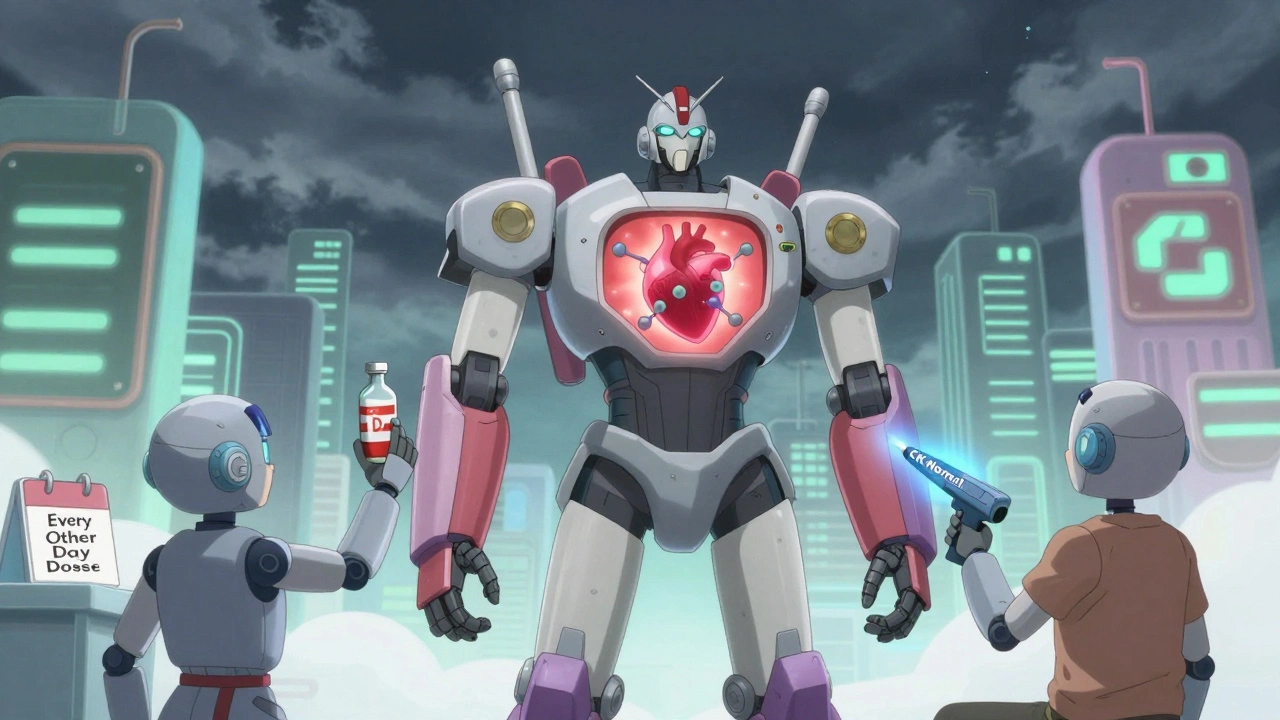
How to Restart: The Three Main Tactics
There’s no one-size-fits-all restart plan. But three strategies work for most people.
1. Switch to a Different Statin
Not all statins are the same. Simvastatin and lovastatin are more likely to cause muscle issues. Pravastatin and fluvastatin? Much lower risk. Why? They’re processed differently in the liver and don’t build up as much in muscle tissue. A 2021 survey of 1,247 patients found that 41% of those who successfully restarted did so by switching from simvastatin to pravastatin.
Start low. If you were on 40mg of atorvastatin, try 10mg of pravastatin. Don’t jump back to your old dose.
2. Reduce the Dose
Statin muscle side effects are dose-dependent. A 2011 review showed high-dose statins (>40mg daily) caused symptoms in 5-18% of users. Placebo? Around 5%. But if you drop to 10-20mg, the risk drops back to near placebo levels.
Many patients think, "If 40mg caused pain, 20mg will too." But that’s not how it works. Muscle sensitivity isn’t linear. A 50% dose reduction often cuts symptoms by 70%. One patient on Reddit wrote: "After stopping atorvastatin 40mg for 6 months, I tried 10mg. Zero pain. Still got my LDL down to 70. Best decision ever."
3. Try Every-Other-Day Dosing
Statins have long half-lives. Atorvastatin lasts 30+ hours. Rosuvastatin lasts even longer. That means you don’t need daily dosing to keep cholesterol down.
Studies show every-other-day dosing lowers LDL by 30-40%, which is enough for many patients. It also cuts muscle exposure by nearly half. One trial found 68% of patients who failed daily dosing tolerated every-other-day without symptoms. It’s not perfect - you’ll need to track your numbers - but it’s a bridge back to daily therapy.
When Rechallenge Is a Bad Idea
There are two situations where you should NEVER restart a statin.
First: Immune-mediated necrotizing myopathy (IMNM). This is rare - less than 1% of cases - but deadly if missed. Patients have high CK, muscle weakness, and test positive for anti-HMGCR antibodies. This isn’t a side effect. It’s an autoimmune attack triggered by statins. Stopping the drug isn’t enough. You need immunosuppressants like prednisone or IVIG. Restarting statins here can cause permanent muscle damage.
Second: Rhabdomyolysis (CK >40x ULN). If your muscles broke down badly enough to threaten your kidneys, you’re not a candidate for rechallenge. The risk of recurrence is too high. Go straight to non-statin options.
What If You Can’t Tolerate Any Statin?
For the 20-30% who truly can’t take any statin, even at low doses, alternatives exist. But they’re not equal.
- PCSK9 inhibitors (evolocumab, alirocumab): Injected monthly or every two weeks. Lower LDL by 50-60%. Proven to cut heart attacks and strokes by 15-17%. But they cost $5,850 a month. Insurance approval is tough, but patient assistance programs can get it down to $0 for many.
- Ezetimibe: A pill that blocks cholesterol absorption. Lowers LDL by 15-20%. Safe, cheap ($10-20/month), but no strong proof it prevents heart attacks on its own. Best used with a low-dose statin - but if you can’t take that, it’s your baseline.
- Bile acid sequestrants (cholestyramine, colesevelam): Lower LDL by 15-20%. Cause bloating and constipation. Hard to take long-term.
Here’s the reality: PCSK9 inhibitors are the only alternative with proven heart protection. But statins are still the gold standard. If you can get back on even a low dose, you’re better off than on anything else - especially if you’re paying out of pocket.

The SAMS-CI: Your Personal Risk Score
The National Lipid Association created the Statin-Associated Muscle Symptom Clinical Index (SAMS-CI). It’s a 5-question tool that predicts your chance of having true statin intolerance.
It asks:
- Are you over 70?
- Do you have kidney disease?
- Are you taking other drugs like fibrates or cyclosporine?
- Do you have hypothyroidism?
- Did your symptoms start within the first 3 months of starting the statin?
Each "yes" adds points. A score of 0-2 means you have a 91% chance your symptoms aren’t caused by statins. That’s huge. It means you’re a perfect candidate for rechallenge.
Most doctors don’t use it. But you can ask for it. Or use the ACC’s online Statin Intolerance Calculator - it’s free, takes 2 minutes, and gives you a printout to show your doctor.
What Patients Say - Real Stories
On HealthUnlocked, a 68-year-old woman wrote: "I stopped simvastatin after 3 weeks of leg cramps. My doctor said, ‘Just stay off it.’ I didn’t feel right - like I was waiting for a heart attack. I asked for pravastatin at 10mg. Two weeks later, I felt better than I had in years. No pain. LDL at 68. I’m back in control."
On Reddit’s r/Cardiology, a man shared: "Tried three statins - atorvastatin, rosuvastatin, pravastatin - all at lowest doses. Still had pain. My cardiologist said, ‘Maybe it’s not the statin.’ Then he checked my vitamin D. It was 18. We fixed that. Restarted pravastatin 10mg. Zero issues."
But others aren’t so lucky. One patient on PatientsLikeMe wrote: "They kept insisting it wasn’t the statin. I tried again. My legs turned to jelly. I ended up in the ER. Now I’m on evolocumab. I hate shots. But I’m alive."
The pattern? Successful rechallenges almost always involve a change in statin, a lower dose, and someone who listened. Failed attempts? Doctors ignored the SAMS-CI, didn’t check labs, and pushed the same dose.
What to Do Next - Your Action Plan
If you’ve stopped a statin due to muscle pain:
- Wait 2-4 weeks after symptoms fully disappear.
- Get your CK, thyroid, and vitamin D checked.
- Ask your doctor: "Can we use the SAMS-CI to see if I’m truly intolerant?"
- If your score is low (0-2), request a switch to pravastatin or fluvastatin at half your old dose.
- Or ask about every-other-day dosing.
- Track symptoms and CK at 2 and 4 weeks.
- If it works - great. If not, we try again or switch to PCSK9 inhibitors.
Don’t let fear or misinformation keep you off a drug that could save your life. Statin myopathy is real - but it’s often not what you think. With the right plan, most people can get back on track.
Can I restart a statin after muscle pain went away?
Yes - if your symptoms have fully resolved for 2-4 weeks. Most people who stop statins due to muscle pain can safely restart with a lower dose, different statin, or intermittent schedule. The key is to avoid jumping back to your old dose and to monitor symptoms and CK levels closely.
Which statin has the least muscle side effects?
Pravastatin and fluvastatin have the lowest risk of muscle side effects. They’re less likely to build up in muscle tissue and don’t interact as much with other drugs. Rosuvastatin and atorvastatin are more potent but carry slightly higher muscle risk at high doses. Simvastatin and lovastatin should be avoided if you’ve had muscle pain before.
Is every-other-day statin dosing effective?
Yes, for many patients. Statins like atorvastatin and rosuvastatin last longer than 24 hours, so dosing every other day still lowers LDL by 30-40%. It cuts muscle exposure and often eliminates symptoms. It’s not ideal for everyone, but it’s a proven bridge back to daily therapy.
How do I know if my muscle pain is really from statins?
Use the SAMS-CI tool - it’s a 5-question clinical index with 91% accuracy in predicting who won’t have symptoms on rechallenge. If your score is low (0-2), your pain is likely not from statins. Also, check CK levels. If they’re normal, the pain is probably from something else - like aging, inactivity, or vitamin D deficiency.
What if I had rhabdomyolysis? Can I ever take a statin again?
No. If you had rhabdomyolysis (CK over 40x the upper limit), you should never restart a statin. This is a serious, potentially life-threatening condition. Instead, use non-statin options like PCSK9 inhibitors or ezetimibe. Your doctor should also test for anti-HMGCR antibodies to rule out immune-mediated necrotizing myopathy.
Are PCSK9 inhibitors worth the cost?
If you truly can’t tolerate any statin, yes. PCSK9 inhibitors reduce heart attacks and strokes by 15-17% in high-risk patients. While they cost $5,850 a month, most insurance plans cover them for patients with documented statin intolerance, and manufacturer assistance programs can bring the cost to $0. For someone with a history of heart disease, the benefit outweighs the cost.
Can vitamin D help with statin muscle pain?
If your vitamin D level is low (below 30 ng/mL), correcting it can reduce muscle pain and weakness - whether or not it’s from statins. Many patients with statin-related symptoms have undiagnosed deficiency. It’s not a cure, but it’s a simple, low-risk step that should always be checked before rechallenge.



Lisa Whitesel
December 10, 2025 AT 19:15Statins are a scam pushed by Big Pharma to keep you dependent. Your body doesn't need synthetic cholesterol blockers. Just eat real food, move more, and stop listening to doctors who treat symptoms instead of causes.
Ryan Brady
December 12, 2025 AT 09:11USA got the best healthcare in the world but somehow we're all just scared to take a pill? 🤦♂️ I took simva for 5 years, felt fine. My cousin quit because his legs "ached" and now he's on a treadmill 3x a week. Guess what? Still has plaque. Idiots.
Darcie Streeter-Oxland
December 12, 2025 AT 19:47It is imperative to underscore that the phenomenon of statin-associated muscle symptoms is frequently conflated with age-related myalgia and vitamin D insufficiency, both of which are readily amenable to correction. The assertion that placebo-controlled trials demonstrate equivalent symptom incidence is not merely statistically significant-it is clinically illuminating. One must exercise due diligence before abandoning a therapy that demonstrably reduces cardiovascular mortality.
Taya Rtichsheva
December 13, 2025 AT 04:35so i stopped statins cause my legs felt like wet paper towels and guess what i got my d levels checked and they were 14 😭 turned out my "statin pain" was just me being a vitamin d zombie. restarted pravastatin 10mg and now i feel like a human again. thanks for the post lol
Mona Schmidt
December 13, 2025 AT 16:06This is one of the clearest, most compassionate summaries of statin rechallenge I’ve ever read. The MEDS approach is not just evidence-based-it’s human-centered. Too often, patients are dismissed as "non-compliant" when they’re simply misinformed. The SAMS-CI tool should be standard in every primary care office. Thank you for emphasizing that muscle pain isn’t always the drug-it’s often the fear, the deficiency, or the dose. We need more clinicians who listen, not just prescribe.
Guylaine Lapointe
December 15, 2025 AT 07:28Wow, this post is basically a love letter to people who’ve been gaslit by their doctors for years. I had a cardiologist tell me my muscle pain was "all in my head" after I stopped atorvastatin. I didn’t even know CK tests existed. Turns out I had low vitamin D and was on the wrong statin. Switched to fluvastatin 20mg every other day. No pain. LDL at 72. I’m not a hero-I just finally asked the right questions. Everyone deserves this info.
Sarah Gray
December 15, 2025 AT 23:35Of course the placebo group reported the same pain-because the study subjects were told statins cause muscle pain. That’s not a nocebo effect, that’s confirmation bias baked into the trial design. You’re just validating the narrative the pharmaceutical industry wants you to believe. Meanwhile, real rhabdomyolysis cases are underreported because labs don’t test CK unless the patient complains. And who complains when they’re told it’s "all psychological"?
Kathy Haverly
December 16, 2025 AT 13:22So what you’re saying is, if I feel like my muscles are melting and my doctor says "it’s probably not the statin," I should just try again? That’s not medicine. That’s Russian roulette with your kidneys. I had rhabdo on rosuvastatin. I’m on PCSK9 now. I don’t care about the cost. I care about not ending up in the ER with my urine the color of motor oil. You can’t tell me to "rechallenge" after that. That’s not advice-that’s negligence.